
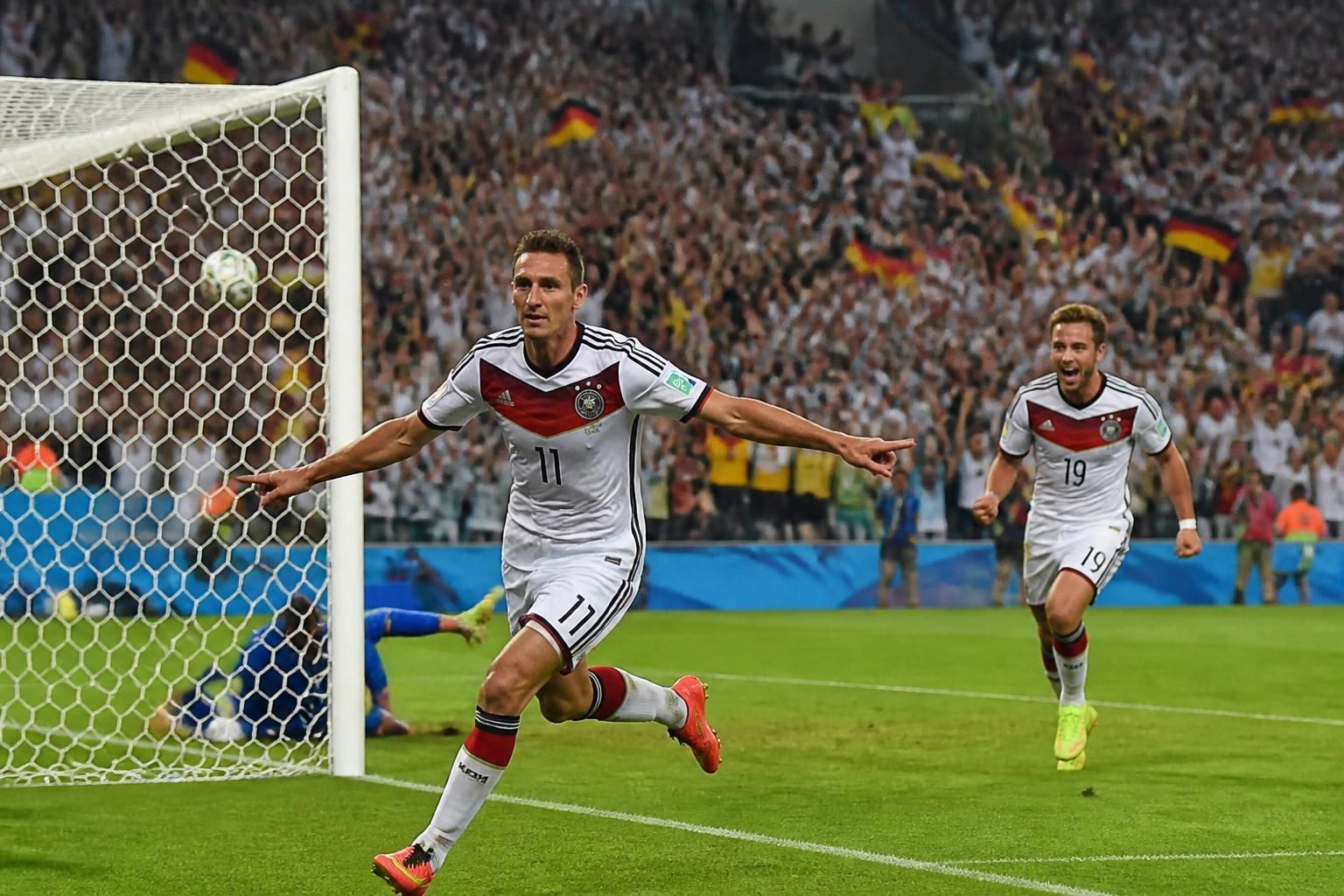
In Brief
- Konami highlights an Epic pack focused on Germany 2014 in eFootball 2026, featuring Miroslav Klose and Mario Götze as the main stars.
- The content directly targets “Dream Team” compositions and the nostalgia of the 2014 World Cup, including finishes, runs, and decisive profiles.
- The associated eFootball Update follows the logic of Thursday rotations, with a pack designed to quickly strengthen a competitive squad.
- The pack’s interest mainly depends on the actual need for a penalty area scorer (Klose) or an offensive joker (Götze) for the chosen play style.
- To optimize coin spending, the priority remains to verify tactical compatibility (animations, runs, role) before pulling.
The Epic pack “Germany 2014” arrives in eFootball 2026 with a clear promise: to inject legendary players associated with one of the most memorable memories of the 2014 World Cup into Dream Team. Miroslav Klose, record goalscorer in the competition after his 16th scored on July 8, 2014 against Brazil (7-1), and Mario Götze, final goal scorer on July 13, 2014 against Argentina (1-0), serve as central figures in a selection that speaks both to football fans and regular rare card collectors.
Behind the “football legends” package, the challenge remains very concrete for an ongoing football video game: to offer immediately useful profiles online, capable of making a difference in the penalty area or turning a match around with a run and a shot. The known Epic pack logic relies on rarity and the “meta” value of cards designed to last several competitive cycles. The interest is measured mostly by the fit with the play style, assigned role, and overall squad balance, otherwise the purchase becomes a mere collector’s gesture.
Epic Pack Germany 2014 on eFootball 2026: what Konami highlights
The “Germany 2014” theme is based on a team that entered history, world champion at the Maracanã on July 13, 2014, after a campaign marked by the July 8, 2014 semi-final (Brazil 1-7 Germany). The Epic pack exploits this collective memory by showcasing legendary players linked to this period, with cards designed for Dream Team.
In practice, this type of pack targets two audiences. Competitors seek immediate impact in ranked matches, while collectors want to assemble football legends and relive a story. On eFootball 2026, the line is thin: a rare card only has value if it fits into a coherent offensive animation and a stable defensive structure.
Klose and Götze: two opposite roles, two uses in a match
Miroslav Klose suggests a simple reading: presence in the penalty area, sense of positioning, effectiveness on crosses and second balls. His historical reference is clear, with a record set on July 8, 2014 during the semi-final against Brazil, surpassing Ronaldo’s 15 World Cup goals.
Mario Götze embodies the moment player: coming on during the match, run behind the defense, oriented control and quick finish, as seen during the final goal on July 13, 2014. In an eFootball 2026 lineup, usage differs depending on whether the team plays fast transitions or seeks to combine through the center, which changes the real profitability of a draw.
eFootball Update: why this pack fits well into the content rhythm
eFootball content rotations are regularly associated with a Thursday eFootball Update, a routine format for players who monitor events, packs, and objectives. The Epic pack “Germany 2014” fits into this mechanism: a strong theme, headline players, and a limited availability window pushing quick decisions.
For Konami, this type of release has an obvious interest: maintaining attention between two larger waves of content while stimulating squad building. On the player side, the effect is immediate on matchmaking: during the first hours, the cards frequently appear online, influencing defensive choices (marking, axial density, management of the near post).
What an Epic pack changes in Dream Team balance
An Epic pack rarely affects just one position. Adding Klose may require adapting profiles around him: winger-crossers, more offensive full-backs, midfielders able to fix and open sides. The benefit is tangible if the play produces crossing and aerial duel situations, otherwise the striker ends up isolated.
Götze rather modifies the channels between midfield and attack. He often fits better with a mobile number 9 or a false nine because short exchanges and late runs create gaps. The gain is seen in tight matches when a single percussion suffices to create a clean shot.
2014 World Cup: the nostalgia argument, but also a real gameplay reference
The 2014 World Cup is not just a marketing backdrop. It provides simple references to understand archetypes: Klose is the penalty area striker who punishes on repeated sequences; Götze is the difference on an isolated action. These profiles also speak to players who build a team around a game principle rather than just accumulating names.
In a football video game, nostalgia becomes useful when it supports reading the field. A player associated with a historic moment gives a usage clue: presence at the far post, crossed runs, depth-taking, or ability to enter the gap. The Epic pack “Germany 2014” precisely exploits this memory, facilitating role choices in a lineup.
Concrete online usage cases: when to bet on Klose, when to prefer Götze
Klose gains value in a play plan with crosses and switches. A typical match: the opponent defends low, closes the center, and lets the wings breathe; the solution goes through tight crosses and runs to the near post.
Götze weighs more when the match is played on the first touch and acceleration after recovery. A frequent scenario: an interception in midfield, two vertical passes, then a run at the right timing to shoot before the defenders return. Effectiveness then depends on execution speed and control cleanliness.
Comparison table: references to choose between Klose and Götze in eFootball 2026
Without entering into numeric ratings that vary by versions and settings, a few measurable references help decide, especially if the Epic pack must fill a precise gap in the squad.
| Measurable Criterion | Klose | Götze | Expected Impact in Match |
|---|---|---|---|
| Priority Zone | Penalty area (penalty spot, near post) | Between the lines and half-spaces | Finish an action vs create a rupture |
| Frequent Actions Type | Crosses, rebounds, deflections | Runs, give-and-go, shots after control | Wing play vs fast transitions |
| Use Timing | Recommended starter if the team crosses a lot | Very strong as a substitute to energize | Fatigue management and rhythm change |
| Squad Synergy | Winger-crossers + attacking full-backs | Mobile 9 + technical midfielders | Complete attack rebalancing |
Optimize your pulls on an Epic pack: simple method to avoid mistakes
An Epic pack attracts by name, but profitability is played on usage. Before spending coins, the priority is to check what the team really produces in matches: crosses, central shots, counterattacks, or possession. This check takes ten minutes on recent match history and avoids recruiting an incompatible profile.
The second step concerns internal competition. If the squad already has a penalty area finisher, Klose becomes a luxury. If the rotation lacks a player able to change the rhythm around the 60th minute, Götze answers a more frequent online need.
Quick checklist before trying the pack
- Check if the team creates at least 5 crosses per match over recent online games.
- Control if conceded goals come mainly from transitions: if yes, favor a profile helping to maintain or play out cleanly.
- Look at the number of shots taken from the center: if most come from sides, a penalty area finisher gains value.
- Identify the most fragile position on the bench: a quality offensive joker often changes more matches than a redundant starter.
- Compare the expected contribution to what is really missing in Dream Team, not just the aura of football legends.
Privacy and cookies: what players see around online services
On online services, players often encounter cookie and data consent screens, especially in web environments. Typical formulations distinguish service provision, audience measurement, fraud prevention, and content or ad personalization according to settings.
The presented options generally separate full acceptance and refusal of additional usages, with variants such as personalization based on browser activity, active search session, or general location. Dedicated tools exist to adjust these parameters, including privacy management pages accessible anytime via a public address like g.co/privacytools.
What do we say about it?
The Epic pack “Germany 2014” is a coherent release to quickly strengthen a Dream Team, because it relies on two very identifiable match profiles: a penalty area finisher (Klose) and a space breaker (Götze). Klose has more value in teams that rely on crosses and presence in the penalty area, while Götze responds better to lineups focusing on transitions and runs. For controlled spending, the decision should be based on real tactical needs observed in recent matches, not just on 2014 World Cup nostalgia. In the online meta, the best gain often comes from a player who fills a precise bench gap rather than an additional starter.
Is the Epic Germany 2014 pack useful if the team already has a top striker?
Yes, but the interest drops significantly. If the squad already has a penalty area finisher, Klose’s contribution may be redundant. The gain can come from a more reliable rotation or a game plan more focused on crosses. In that case, Götze can sometimes bring more by coming on during the match to vary runs and speed up the play.
Is Klose rather suited to wing play in eFootball 2026?
From a gameplay perspective, Klose gains value mainly when the team produces crosses and attacks the penalty area with multiple players. If attacks mostly go through the center and long-range shots, his influence decreases. Teams that frequently switch the play and send many balls into the box make better use of this profile.
Should Götze be a starter or super-sub in a Dream Team?
The most frequent usage is as a joker, especially if the match closes after the hour mark. His impact comes from rhythm changes, runs between defender and full-back, and the ability to finish quickly. As a starter, he can also work if the team plays short combinations and looks for gaps in half-spaces.
Which historical references are linked to Klose and Götze during the 2014 World Cup?
Klose scored his 16th World Cup goal on July 8, 2014 against Brazil, setting a competition record. Götze scored the final goal on July 13, 2014 against Argentina, delivering the world title to Germany. These two dates structure the “Germany 2014” identity highlighted by the pack.