
In Brief
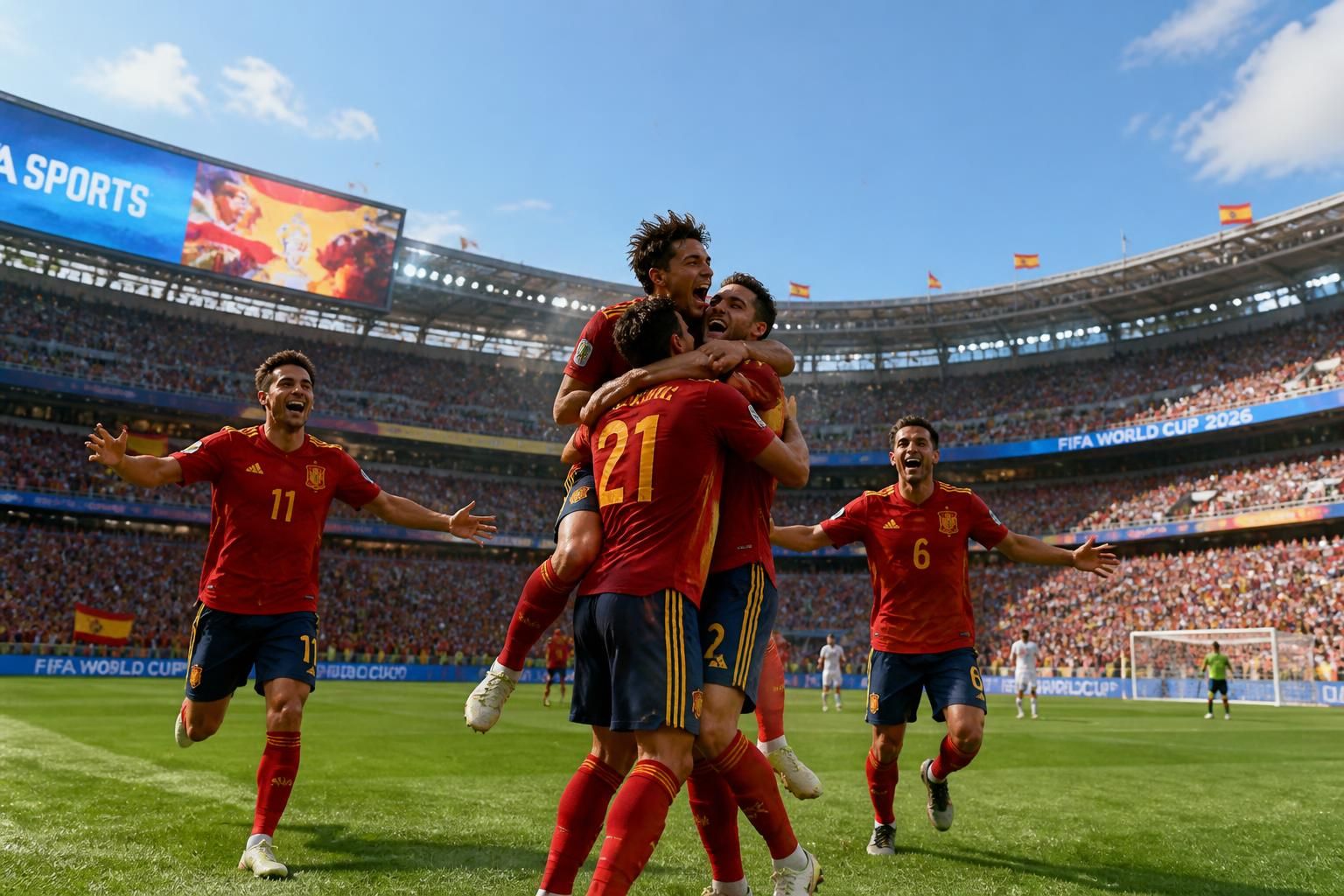
- On Sunday, July 19, 2026, Spain won the 2026 World Cup by defeating Argentina 1-0, after a closed and highly tactical final.
- Before the tournament, EA Sports published a prediction via a simulation on its video game EA Sports FC 26, announcing a final victory for La Roja.
- Spain’s performance is part of a recent series of titles, with a style based on ball mastery and managing weak phases.
- The interest in these predictions remains mainly media and marketing-related, but the publisher claims a series of correct forecasts over several editions.
- This success reignites the debate about the role of data, models, and simulations in interpreting a global football championship.
On Sunday, July 19, 2026, Spain claimed the 2026 World Cup by beating Argentina 1-0, a scenario that sparked reactions far beyond the pitch. In East Rutherford, New Jersey, La Roja locked down a tense final, played on details, before tipping the match at the right moment. The story could have been just another triumph, continuing a squad already European champion two years earlier. But another narrative emerged right after: that of EA Sports, which had announced this result in advance through a prediction produced by simulation on its video game EA Sports FC 26.
This is not the first time the American publisher has entered the conversation during major competitions. At every World Cup, the same mechanism returns: a simulation model, an official announcement, then a real verdict that sometimes fits the script. In 2026, the alignment was total, and the event became a case study on how sport, marketing, and video game culture feed each other. Spain’s victory, meanwhile, remains a matter of football, management, and composure, with a final Argentina never managed to open.
EA Sports FC 26 and the 2026 World Cup prediction: what the simulation announced
Before the tournament kickoff, EA Sports communicated a prediction derived from a simulation performed on EA Sports FC 26: Spain announced as world champion. The principle has been well known to the general public since the FIFA predictions era: running a full competition, letting the match engine simulate virtual matches, then publishing the winner as a wink to fans.
In the case of the 2026 World Cup, the publisher especially benefited from perfect timing: La Roja actually lifted the trophy on Sunday, July 19, 2026. The media interest is immediate because the prediction becomes a simple narrative element to share, even with people who don’t follow video games daily. The result also strengthens the visibility of the title at the moment when public attention is at its highest, at the heart of the competition.
Why these predictions work so well in popular narrative
The mechanism is effective because it mixes two mainstream cultures: national team football and sports video gaming, often played among friends, online or locally. A “correct” prediction is easily told, without needing to explain a statistical model.
In fact, a game simulation is not a forecasting tool in the scientific sense. However, it can capture general trends because it is based on roster evaluations, team styles, and gameplay parameters designed to reflect a certain balance. The buzz therefore rests less on precision than on the ability to produce a story immediately readable after the victory.
Spain – Argentina (1-0): the match that validated EA Sports’ prediction
The final was played on a minimal margin: 1-0 for Spain. At this level, the reading is clear: one team controls, the other endures without collapsing, then a late switch suffices to tilt a world championship. The tight score fits well the image of a modern final, where mistakes cost more than audacity yields.
Played in East Rutherford (New Jersey), near New York, this last step crowned a Spain able to impose a tempo and keep a cool head. Argentina, announced dangerous, did not find the opening, and La Roja ended up making the difference at the useful moment. The victory also reactivated a dynamic already started since the European title earned two years earlier, establishing a rare continuity at the national team level.
Media reactions around La Roja’s triumph
The triumph triggered mixed readings depending on the country: celebration in Madrid, bitterness in Buenos Aires, and tactical analysis elsewhere. This contrast is part of the drama of a World Cup: the same action is perceived as mastery or as a missed opportunity.
The key fact, in this narrative, remains the overlapping of two simple stories: a Spain confirming on the pitch, and a video game that had “seen” it right. In the attention economy, this duo is formidable because it connects sport to a familiar cultural object and gives an immediate angle to post-match discussions.
What is the value of an EA Sports prediction on a football competition
A prediction made via EA Sports FC 26 is not to be read like a poll nor an official statistical projection. It is understood as a staging: the publisher uses its match engine, team ratings, and parameters to produce an overall scenario, then transforms it into communication content.
For the public, the interest is elsewhere: comparing real and virtual, spotting gaps, debating plausibility. In a global championship, the unpredictability remains huge, between current form, injuries, emotional management, and effectiveness in the box. Even with a simulation, reality retains a breaking capacity that no one masters.
Concrete limits: what the simulation doesn’t model well
The video game manages parameters, not full human contexts. A coach’s choices under pressure, the nervousness in a penalty shootout, or dealing with an early card are hardly “predictable” in a robust way in a simulation.
Still, the device works because it gives an impression of objectivity: a machine launches matches and “announces” a winner. In the framework of a 2026 World Cup, Spain’s victory offers a perfect example of this phenomenon, where sporting success validates a narrative already prepared.
Table: actual victory and video game prediction, key facts of the 2026 World Cup
The elements below recap central facts around Spain’s victory and the EA Sports signed prediction, with directly observable and comparable data.
| Measurable Element | Data | Context |
|---|---|---|
| Final date | July 19, 2026 | Last match of the tournament, official Spanish triumph |
| Final score | Spain 1-0 Argentina | Closed match, decision on a key action |
| Final venue | East Rutherford, New Jersey | Stadium near New York, strong media coverage |
| Prediction support | EA Sports FC 26 | Tournament simulation used by EA Sports to announce a winner |
What Spain’s 2026 victory says about football beyond video gaming
Spain World Champion in 2026 is first of all a team that wins by assuming an identity: control, patience, field occupation, and an ability not to break apart in moments when the opponent pushes. The 1-0 final win against Argentina illustrates a logic of control more than demonstration.
The modern context favors this type of team: high physical intensity, well-prepared opponents, reduced spaces. Under these conditions, the ability to maintain a game plan for 90 minutes or more becomes decisive. Spain also benefited from a momentum installed since their European title acquired two years earlier, arriving with a status and confidence rarely maintained from one competition to another.
Factors making a team “predictable” in a simulation
A team is more “predictable” for a simulation when its style is stable and its performance less dependent on isolated feats. Organized collectives, capable of imposing clean possession and limiting opposing transitions, mechanically reduce the variance of a match.
In a short competition like a World Cup, this guarantees nothing, but it helps a machine produce coherent scenarios. For the general public, the reading becomes simple: EA Sports’ prediction seems credible because it fits an established image of La Roja, and the victory locks this narrative.
So, what do we say about it?
EA Sports’ prediction for the 2026 World Cup does not carry scientific proof, but it fulfilled its role: creating a clear story, validated by the field, at a moment of maximal global attention. Spain’s 1-0 victory over Argentina on Sunday, July 19, 2026, gives the publisher an almost ideal communication case. The strength of the operation lies in its legibility: a simulation, a winner, then the same result in the real world. Fundamentally, football remains too contextual to be “guessed” sustainably by a video game, but the cultural impact of this type of prediction is now established.
How does EA Sports produce a winner prediction for a World Cup?
EA Sports generally relies on a simulation performed in its video game, here EA Sports FC 26. The match engine makes teams face each other virtually taking into account game parameters (ratings, styles, rosters), then a winner is announced. It is entertainment content designed to accompany the sporting event.
What was the score of the Spain – Argentina final at the 2026 World Cup?
The 2026 World Cup final ended with a 1-0 victory for Spain against Argentina. This score reflects a tight match where La Roja preserved defensive balance before making the difference on a decisive action.
Where was the final of the 2026 World Cup played?
The final was contested in East Rutherford, New Jersey, near New York. This setting enhanced the event’s media exposure, with a full stadium and massive international coverage, as for major FIFA competition finals.
Can we trust predictions from a football video game?
A prediction from a video game should not be interpreted as a statistically reliable projection. It can produce plausible scenarios especially for stable teams, but it does not fully model the uncertainties of real sport (pressure, injuries, match events). Its main interest remains narrative and media-related.