
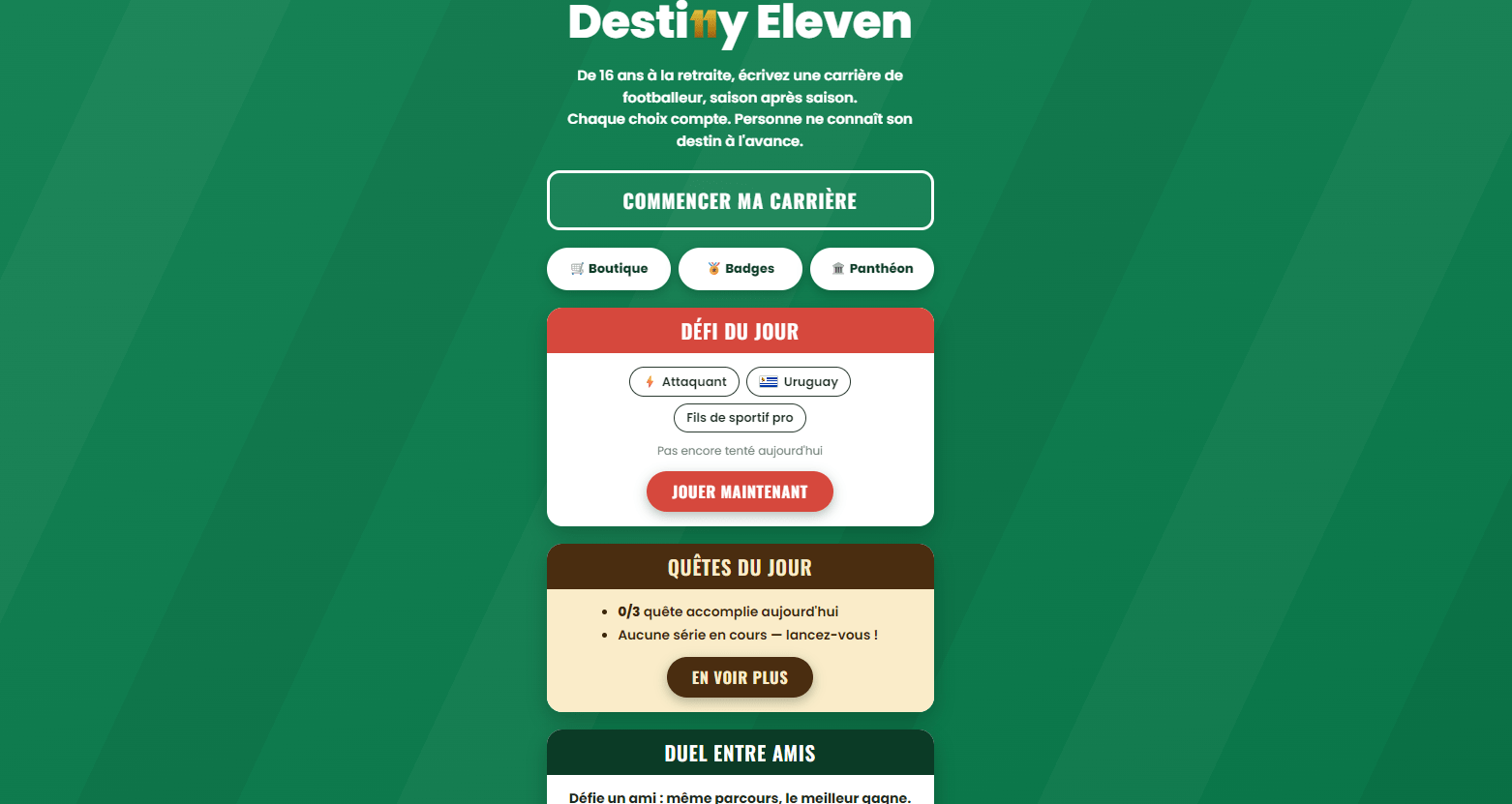
On July 20, 2026, Destiny Eleven was launched as a narrative football simulation freely accessible from a browser. The concept is based on a sequence of textual decisions: the player creates a 16-year-old prospect, goes through each professional season, and upon retirement receives a rating out of 100. Behind this straightforward presentation lies a system where playing time, form, morale, transfers, and random events permanently alter the sporting trajectory.
The game quickly found its audience thanks to its short sessions, free access, and replayability potential. However, it demands more than just a series of intuitive responses. A successful career requires understanding annual summaries, preserving several resources, and adjusting the risk level according to the character’s age. With the score cap set at 97 out of 100, pursuing theoretical perfection often leads to taking unnecessary risks. This guide offers a pragmatic method to progress, exploit tokens, prepare badges, and build a coherent record without sacrificing individual statistics.
In brief
The player starts at 16 years old and receives a final score upon retirement.
The maximum available score is capped at 97.
Form, morale, rating, and market value influence events each season.
Tokens obtained through quests provide access to a shop and two equippable permanent perks.
Save data remains stored in the browser used, without account synchronization.
Discover Destiny Eleven: free browser-based narrative football career simulation
Destiny Eleven puts the player in the shoes of a teenager trying to become a professional footballer. No match is controlled directly. Performance results from decisions made between matches, the character’s attributes, and a degree of chance governed by the game’s rules.
A game follows the entire career, from initial training sessions to retirement. Each season presents choices: stay at the club, accept a transfer, change role, or handle a personal event. The summary then displays statistics, trophies, and rating progression. This format suits quick sessions on both computers and mobile devices.
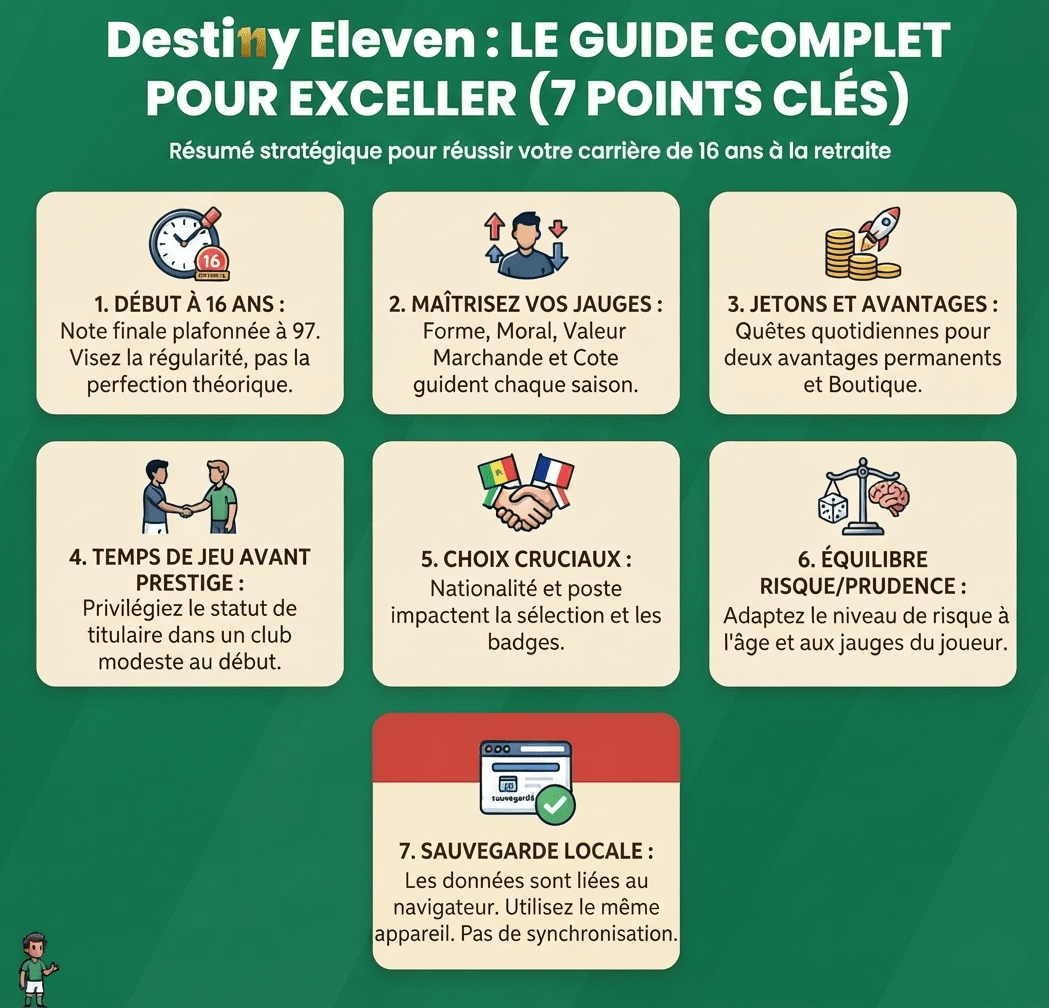
Understanding Destiny Eleven’s unique concept: decisions, controlled chance, and career score
Each choice modifies a probability or a resource. An ambitious decision can lead to a major transfer, a selection, or a trophy, while exposing the character to morale drops, injuries, or a place on the bench. Chance thus prevents mechanically replicating the same career.
This uncertainty remains manageable. A player in good form, as a starter and well supported generally benefits from favorable conditions. Conversely, a series of bets when gauges are low amplify failures. The final score combines several dimensions, including consistency, statistics, and record. The 97 cap invites pursuing a robust trajectory without considering 100 as an attainable goal.
Destiny Eleven: technical features and independent development context
The project was independently developed by Maxence Pigné in two months. It runs without download, registration, or advertisements. Free access is exclusively via a compatible browser, whether on a computer screen or a phone.
No dedicated mobile application exists. An icon added to the home screen remains a shortcut to the site and does not turn the service into a native app. Development by Maxence Pigné is accompanied by regular updates which may adjust balance, add events, and expand available modes.
A more complete alternative: La Relève
La Relève.
Same promise: from 16 years old to retirement, free, in the browser, without account or download. Except here, decisions are not only sportive.
What you decide
-
16 years old
A fake agent demands his fee. Pay, or refuse and risk it.
-
19 years old
Nitrous oxide circulates on a party night. Refusal does not go unnoticed.
-
24 years old
A youth player from the academy pushes you out. Sabotaging him remains an option.
And ten seasons later, these choices come back to haunt you in the final summary.
- Cause board
- Generation rival
- One newspaper headline each season
- Heritage between careers
- Exportable save
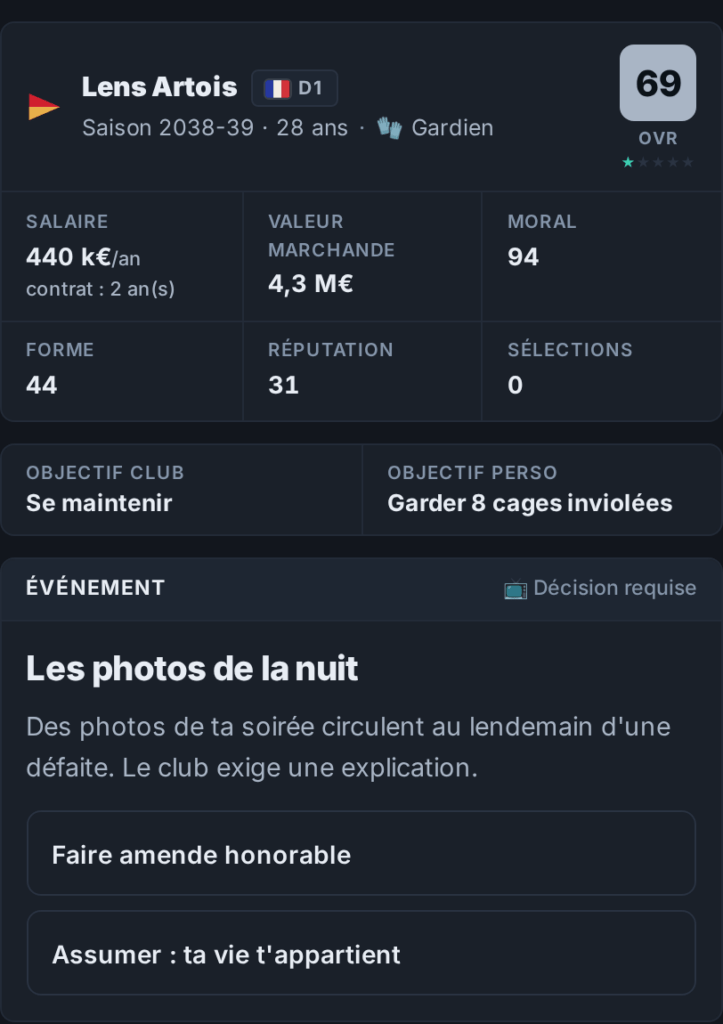
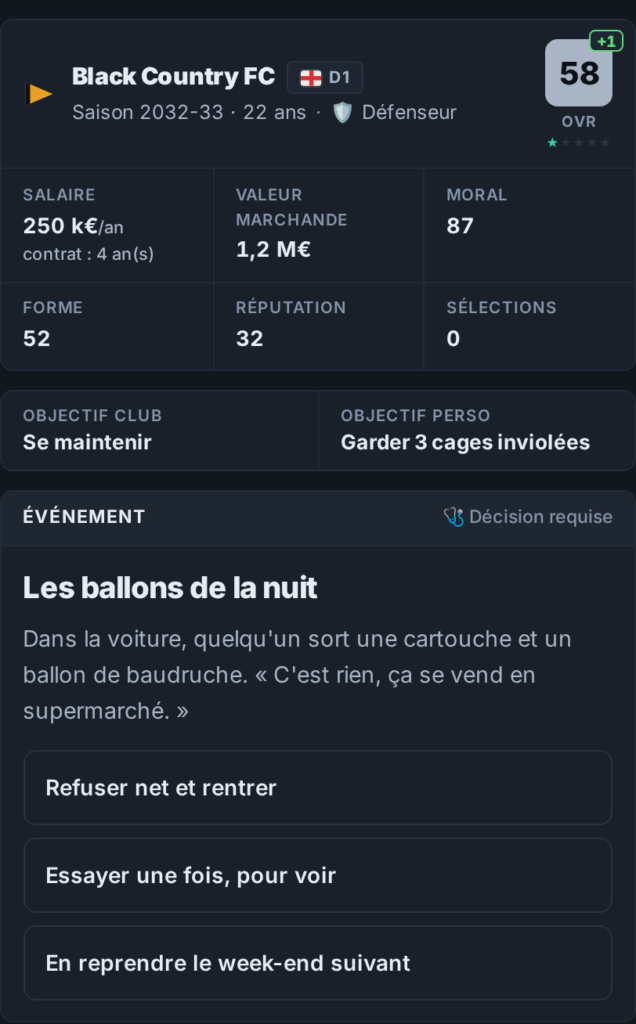
Basic mechanics to master in Destiny Eleven: form, morale and market value gauges
Form reflects the character’s ability to deliver good performances. Morale expresses his satisfaction and stability. Lower levels reduce the chances of successfully completing an important action and can damage the following season. A rest option or a reassuring environment can then be more beneficial than an immediate reward.
Market value measures the economic interest generated by the player. His rating represents more his sporting and media status. These indicators progress with playing time, goals, assists, and titles. They decrease after long periods of inactivity or mediocre results.
Indicator | Main effect | Warning signal | Proper action |
|---|---|---|---|
Form | Quality of performances | Repeated drop | Rest and cautious decision |
Morale | Character stability | Lasting dissatisfaction | Playing time or change of environment |
Market value | Market attractiveness | Prolonged stagnation | Accumulate starting appearances |
Rating | Sporting recognition | Decline after a poor season | Seek a regular role |
Crucial first choices in Destiny Eleven: nationality, position, and starting club explained
Character creation defines nationality, position, origin, adolescence, entourage, and first team. Origin and adolescence determine some initial bonuses. The entourage can support morale or promote a more ambitious approach, with visible consequences on the first events.
Position frames statistical production: a forward will mainly be judged on goals, while a midfielder may emphasize assists and consistency. The starting club sets competition level and chances of starting. A prestigious structure offers strong exposure but its squad may slow down progression for a still low-rated youngster.
Essential starting strategies in Destiny Eleven to optimize fast progression
The first years build the career’s foundation. Between 16 and 20 years old, priority is to accumulate appearances and obtain positive season summaries. An attractive offer should be evaluated according to the promised role, competition, and loan possibilities.
Prioritize playing time over club prestige: a key lever
Prestige becomes useful when the character already has a solid rating. At the start, a starter status in a modest team often produces more statistics than a secondary role in a large squad. Around twenty matches can transform market value and trigger better-suited offers.
Refusing a major offer does not forbid reaching the elite later. The game rewards sporting continuity, especially when several favorable seasons follow. The annual summary must be checked before each transfer and the progression of appearances carefully monitored.
Impact of nationality and position on selection and strategic badges
Nationality determines the level of competition for national team selection. A major nation may offer a prestigious international record, with more difficult team access. A smaller selection pool sometimes increases early call-up chances, even if collective potential seems lower.
Some badges require production linked to position or a specific international trajectory. A goal-based objective fits better with an offensive role. Before creation, badge conditions should be read carefully and the profile adapted from the initial screen.
Advanced tips to perform in Destiny Eleven: balance between risk and caution
An effective strategy alternates safe decisions and calculated bets. Early on, stable options protect development. During the best years, an ambitious transfer or responsibility-taking can accelerate the career. After 30 years old, preserving starter status and gauges becomes more important.
Manage form and morale as essential resources for success
A gauge should not be considered in isolation. Good form combined with low morale can produce an inconsistent season. Before a risky choice, it is better to have sufficient reserves in both indicators. If several alerts appear, a conservative option limits negative effect accumulation.
The useful routine is to read the event result, check variations, then consult the full summary. This discipline prevents chaining choices only at the pace of animations and helps distinguish a random accident from a structural problem linked to sporting status.
Accept loans and modest clubs to guarantee optimal playing time
A loan can immediately revive a young substitute. He usually retains return potential while getting minutes elsewhere. This solution becomes relevant when the owning team has several established starters at the same position.
Modest clubs play a similar role. They sometimes offer a central role favorable to goals, assists and value improvement. The operation should be judged after a full season, as a few favorable events are not enough to measure its effectiveness.
Maintain a sustained progression pace before 30 to ensure career end
The years before 30 concentrate the ascent potential. Status must be stabilized, selections obtained, and solid statistics built to absorb a later decline. A trajectory interrupted over several seasons becomes difficult to correct when comeback possibilities decrease.
After this threshold, maintenance takes more space. A league change or a return to a less exposed team can prolong playing presence. This management also offers an extra chance to add a trophy to the record.
Side economy and permanent perks in Destiny Eleven: role of tokens and shop
Tokens form a currency distinct from footballer income. They notably come from quests and are used in the shop. Their interest goes beyond cosmetic aspects, as some purchases grant permanent perks to equip before a new game.
Regular token collection: the key to unlocking two permanent perks
Daily quests encourage regular logins and specific goals. Accumulating tokens without immediate spending allows targeting the improvements best suited to one’s method. The shop therefore requires planning separately from the main game.
Two perks can be equipped simultaneously. A consistency-focused combination helps secure first seasons, while an offensive set supports record-chasing. Quests provide the most predictable way to strengthen this token reserve.
Influence of permanent perks on overall performance and Day Challenge specificity
A career launched without permanent improvements is at a disadvantage compared to a prepared profile. Perks do not guarantee success for every decision but increase the average quality of a game. They must be selected before starting, as the shop is not intended to freely adjust an already started trajectory.
The Day Challenge disables these bonuses so all participants have the same parameters. Tokens gained from quests hence create no gap there. This rule values situation reading and direct risk management.
Badges, additional modes, and differentiated strategies to personalize your Destiny Eleven career
Badges introduce specialized objectives. Some require statistical output, unusual paths, or international success. They may conflict with achieving the best rating, as obtaining them sometimes requires a transfer, role, or risk level that is not cost-effective.
Choose and prepare your playstyle before each career based on targeted badges
A dedicated attempt starts by studying the conditions. The initial profile, equipped improvements, and transfer policy must serve the same goal. Targeting too many conflicting badges disperses decisions and makes the final summary hard to interpret.
A simple preparation combines a main objective with a compatible secondary objective. Tokens can finance adapted bonuses, then quests rebuild the reserve for the next attempt. This organization limits games launched without a precise strategy.
Explore Day Challenge, Story Mode, and Friend Duel to vary challenges
The Day Challenge offers a common setup, useful for comparing results. Story Mode provides a more guided narrative structure. The Friend Duel adds a competitive dimension based on shared conditions and direct comparison.
These formats avoid endlessly repeating the standard path. Story Mode suits those seeking scripted situations, while the duel rewards adaptability. Particular rules force reassessing acquired automatisms in the main game.
Common mistakes to avoid to maximize your performance in Destiny Eleven
Beware of compulsive play without analyzing season summaries
The speed of decisions encourages immediately restarting a career. This pace hides the causes of a poor result. The season summary allows noting appearances, statistics, value evolution, and gauge levels achieved.
An effective method identifies a dominant error after each retirement: premature transfer, neglected morale, or lack of starts. The next game then serves as a targeted test. Quests should not push multiplying sessions without analysis.
Don’t seek the perfect choice: accept the game’s random factor
No response guarantees the same outcome systematically. Mentally reloading a decision or attributing each failure to a wrong option leads to erroneous conclusions. The overall logic must be evaluated over several seasons and accept that a reasonable bet can fail.
Comparisons become relevant when context remains close: same age, comparable gauges, and similar status. Observed differences then inform about game probabilities, without turning uncertainty into an absolute rule.
Avoid early transfers to big clubs that limit playing time
An attractive offer received at 18 can interrupt a favorable dynamic. The new club usually has stronger competition, reducing appearances and slowing rating growth. The character then risks morale loss before a loan is proposed.
Transfer becomes more coherent after one or two full seasons. Established statistics increase chances of obtaining a useful status right away. Prestige then contributes to collective titles without erasing personal output.
Medium and long-term strategic stakes: balance between individual performance and collective record
Goals and assists describe individual performance. The record also depends on squad quality, competitions contested, and collective events. A prolific forward in a mediocre team can show excellent numbers while ending with few trophies.
Conversely, a substitute in a dominant team can accumulate titles with reduced statistics. To aim for a high score, both dimensions must be articulated: perform regularly during development, then join a team capable of winning when the character’s status is solid enough.
Finely manage risk and safety to aim for a high career rating
Risk level must evolve with the situation. A young starter progressing well can accept an ambitious decision if form and morale remain high. A veteran close to a reward or record should protect sporting continuity.
End-of-career rewards consider the entire trajectory. A single exceptional season does not always compensate for several years on the bench. Consistency, cumulative statistics, and record thus form a set to manage over time.
Specific technical constraints of Destiny Eleven: local save and multi-device precautions
Save is kept locally in the browser. Without an account, it is not synchronized between a computer and a phone. Opening the game on a second device hence creates a separate environment, with its own progression, tokens, and shop purchases.
Clearing the cache, deleting site data, or changing browsers can make saves and validated quests disappear. Private browsing has the same risk when the session closes. Maxence Pigné having chosen a no-registration system, technical caution boils down to keeping the same device and software for important attempts.
What do we say about it?
Destiny Eleven deserves a recommendation for its free access, straightforward format, and coherent risk-reward system. Its main weakness concerns local saving, poorly suited for those switching between several devices. To perform well, the most reliable strategy consists of securing playing time early, equipping two permanent bonuses, and analyzing each summary before restarting a game. This method leaves room for chance while reducing decisions that compromise several seasons.
Can a save be transferred to another device?
No account synchronization is offered. Progress remains linked to the browser’s local data. Changing device, using different software, or clearing cache may thus cause loss of saves, purchases, and already validated objectives.
Should tokens be spent as soon as a purchase becomes available?
It is preferable to examine the whole shop and save for two coherent upgrades. Immediate spending may delay acquiring a combination better suited to the profile, target badge, or planned trajectory.
How long does it take to finish a game?
Duration varies depending on reading speed and attention to summaries. The text format allows short sessions, but a methodical attempt takes longer as it requires controlling gauges, yearly results, and transfer proposals.
Does a bad first season force a restart?
A difficult start remains recoverable if the character regains starts and stabilizes morale. A loan or move to a less competitive team can revive trajectory. Restarting becomes mainly relevant when several consecutive seasons have blocked development.