
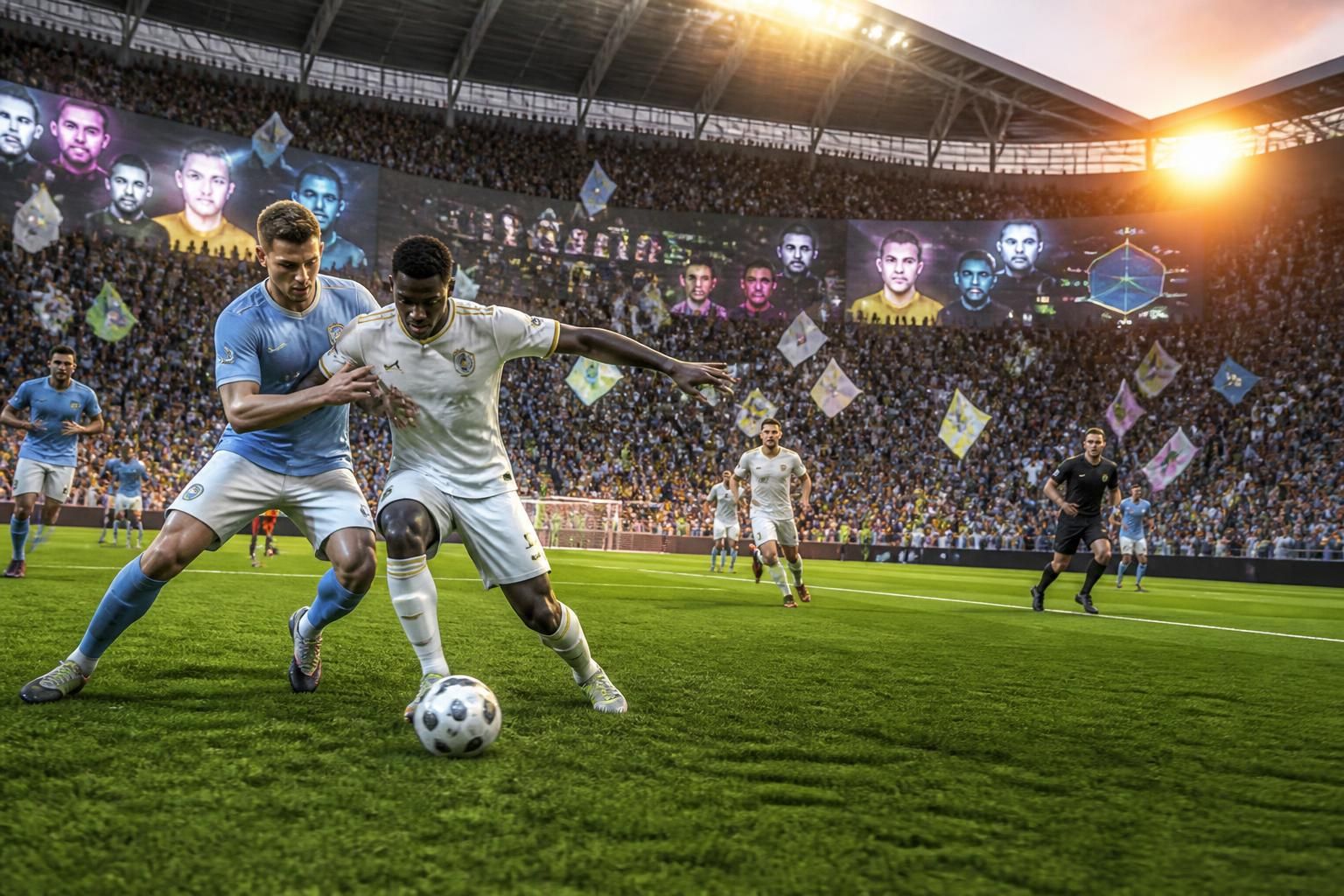
In Brief
- EA Sports FC 27 focuses on advanced realism with a claimed volume of over 21,000 athletes, more than 800 clubs and national teams, over 140 stadiums, and more than 35 championships.
- A new social pillar, The Grounds, structures the experience around an interactive community and activities designed for online multiplayer.
- The video game aims for a more stable immersive experience during matches, with advanced graphics and more consistent animations on contacts.
- The issue of balancing and the economic model around connected modes is expected to be central at release.
- Date shown in the provided elements: release announced for September 25 (platforms not specified in the transmitted information).
Over 21,000 modeled athletes, more than 800 clubs and national teams, over 140 stadiums, more than 35 championships: EA Sports FC 27 brandishes massive figures to defend advanced realism and a sports simulation ever closer to television standards. The publisher is not just selling a new annual iteration of virtual football: the stated ambition relies on a coherent whole, where staging, the variety of match contexts, and the density of licenses serve the same goal, that of a video game more credible in its rhythms, duels, and collective play.
In this preview, the other focus is obvious: the social layer takes a structural place via The Grounds, presented as an open world oriented towards street football, designed to bring an interactive community to life beyond just chaining matches. This promise of innovation does not erase the usual questions around connected modes: stability, matchmaking, cheating, monetization. But the orientation is clear: to push the immersive match experience and give online multiplayer a more continuous field of expression than traditional menus.
EA Sports FC 27: Advanced Realism in the Service of Sports Simulation
EA Sports FC 27 is first based on a foundation of quantified content, which conditions the variety of game situations. Announcing more than 35 championships and over 140 stadiums is not just a marketing argument: it multiplies atmospheres, pitches, lighting, and pressure contexts, all elements that shape the perception of a sports simulation when matches follow one another.
Advanced realism also plays on visual coherence and reading actions. Advanced graphics are not enough if contacts seem “scripted” or if runs lack collective logic. The implicit objective is therefore to reduce the dissonance between what the eye perceives (postures, inertia, duels) and what the controller triggers (response time, body orientation, collisions), for that is where the credibility of virtual football over time is won.
Licenses and Content Density: Why the Announced Figures Matter in Match
Over 21,000 modeled athletes and more than 800 clubs and national teams also promise deeper squads and more credible benches, including in less exposed competitions. Over a career mode season or a series of ranked matches, the variety of profiles limits the impression of replaying the same matchups, a frequent complaint about annual iterations.
On the field, this density translates into animations and morphologies intended to better differentiate players, especially in duels, information gathering, and shots. An explosive winger must feel different from a more physical fullback; otherwise, advanced realism remains just a cosmetic. The challenge is simple: that style differences are readable without gameplay becoming unpredictable.
The first images emphasize staging and the volume of situations, but the essence will be judged on the regularity of played sequences. A trailer can glorify a top-corner shot; a full match reveals the truth about runs, defense-attack transitions, and the variety of set pieces.
The Grounds: An Interactive Community Designed for Online Multiplayer
The Grounds is presented as an open world oriented towards street football, with a logic of appointments, activities, and more direct socialization. The idea is to extend the game beyond the 90 minutes by providing a space where player identity, progression, and interactions become a daily engine. For a video game that lives by the rhythm of competitive seasons, this type of hub aims to reduce friction between “connecting” and “playing.”
On the interactive community side, the interest is twofold. On one hand, to create clear paths for playing together without going through a succession of screens. On the other hand, to encourage expression (challenges, events, gatherings) that feeds discussions and retention. The risk is known: if the space fills with repetitive objectives or overly aggressive incentives, innovation turns against the immersive experience and tires more than it gathers.
What The Grounds Concretely Changes for Playing Together
In a hub approach, the important thing is the complete chain: joining friends, finding an activity, starting a game, returning to the hub without interruption. If this loop is fast, the online multiplayer gains spontaneity and the game approaches the uses of social platforms, where action launches in a few seconds.
To clarify what players can expect from such a mode, here are the tipping points generally observed in social hubs of other games-as-a-service, applied here to virtual football:
- More readable matchmaking, with identifiable activities rather than a pile of menus.
- More “visible” progression, through a space where rewards and customization are shown, not just accumulated.
- Easier encounters, useful when a group is incomplete and a team needs completion.
- More frequent events and challenges that structure the game week without requiring a competitive mode.
- More complex moderation potential, as a social space exposes more to toxic behaviors.
If these elements are well calibrated, The Grounds becomes a true center of gravity. Otherwise, it will remain a detour before starting a match, which would neutralize its promise.
In this type of mode, technique counts as much as concept: navigation fluidity, loading times, server stability, and quality of online synchronization. Without these bases, the interactive community fragments, as groups disperse to the most reliable modes.
Advanced Graphics and Immersive Experience: What Happens Controller in Hand
Advanced graphics mainly serve to make micro-situations readable: oriented control, contact from behind, ball protection, aerial duel. A finer image helps, but the immersive experience depends on the coherence between the animation and the result of the action. A tackle that “sucks” the ball or a poorly interpreted obstruction immediately breaks the sports simulation sensation.
In EA Sports FC 27, the challenge is to make match reading more stable: collective movements, sliding lines, better synchronized runs. Over long sessions, these are the details that reduce frustration, especially in online multiplayer where every inaccuracy turns into accusations of luck or imbalance.
Table: Factual Benchmarks on the Declared Ambition
| Element | Announced Value | Expected Impact in Game | Point of Vigilance |
|---|---|---|---|
| Athletes | Over 21,000 | More diversity in squads and styles | Real differentiation of profiles controller in hand |
| Clubs and National Teams | Over 800 | Broader choice in solo and online modes | Balancing and exploitable level gaps |
| Stadiums | Over 140 | Varied atmospheres, enhanced staging | Readability (cameras, lighting, contrasts) |
| Championships | Over 35 | Calendars, play styles, and multiple competitions | Depth of modes and repetitiveness of objectives |
These benchmarks give an idea of the scope aimed for. They do not say everything about the feeling, but they frame the ambition: license density, variety of contexts, and growth of the social layer.
Privacy, Cookies, and Personalization: What Players See Around the Game
Around a mass-market video game, the experience is not limited to the field: web pages, videos, streaming platforms, and associated services often display consent banners. In common formulations, cookies and data (including the IP address) serve to provide a service, secure against spam and fraud, measure audience, then, if accepted, personalize content and advertising, and improve products.
For an interactive community, these choices have a concrete effect: video recommendations, news highlights, targeted advertising, and sometimes experience adjustments based on declared age. The practical point to remember is the existence of management options, often presented via a “More options” button, and access to dedicated tools such as g.co/privacytools to control privacy settings.
What Do We Think?
EA Sports FC 27 displays a coherent direction: advanced realism supported by an impressive volume of licenses, and an interactive community structured around The Grounds. If the promise is confirmed, online multiplayer will benefit the most, with a smoother and less fragmented practice. The potential weak point lies in balancing and the “service” load: a social hub forgives neither repetitiveness nor instability. On paper, innovation seems more tangible than in some recent iterations, because it touches how to play as much as appearance.
Does EA Sports FC 27 really release on September 25?
The provided elements indicate a release announced for September 25. In the absence of official precision copied here about platforms and editions, the date should be considered as communicated in this information, to be confirmed on Electronic Arts channels at the time of preorders opening and store page publishing.
Does The Grounds replace the classic modes of EA Sports FC 27?
The Grounds is presented as a separate mode centered on a social space and street football-oriented activities. Nothing indicates that it removes the traditional match formats. The main interest is to offer a more direct entry point to online multiplayer and to continuously animate the interactive community.
What elements support the promise of advanced realism?
The announced figures (over 21,000 athletes, over 800 clubs and national teams, more than 140 stadiums, over 35 championships) reinforce the variety of contexts and squads, which weighs on the credibility of a sports simulation. Realism will be especially judged by the coherence of animations, contacts, and collective movements, controller in hand.
Are advanced graphics enough to guarantee an immersive experience?
No, because the immersive experience mainly depends on the coherence between what is displayed and what is calculated in game: inertia, collisions, duels, runs, and transitions. Advanced graphics amplify the match feeling, but gameplay stability and netcode quality in online multiplayer remain decisive to avoid frustration.