
| Key takeaways from this review of Football Manager 26 on PC |
|---|
| Unity engine and enhanced graphics that transform the match atmosphere. |
| A true tactical revolution: distinct plans in possession and out of possession. |
| A more nuanced coach profile, impacting leadership and locker room management. |
| Introduction of women’s football with 14 leagues in 11 countries and solid data. |
| User interface redesigned, denser but initially unsettling. |
| Some launch bugs, but quick updates improve the experience. |
| The football simulation remains the richest on the market, ideal for enthusiasts. |
The new installment takes measured, sometimes bold risks. The switch to Unity changes the perception of the pitch and breathes new life into match evenings. The PC game maintains its legendary depth but dares a revision of its benchmarks. This approach fuels a clear ambition: to make tactics visible, readable, and exciting, beyond the numbers.
This video game review focuses on the key contributions of Football Manager 26, from modernized football strategy to the now present women’s championships. The user interface changes habits but aims for greater analysis speed over time. For this new season, the heart beats even stronger on the pitch, without sacrificing team management and detailed analysis. The following lines dissect these evolutions based on concrete situations and practical cases.
Matches and Unity engine: enhanced graphics and immersion for Football Manager 26’s new season
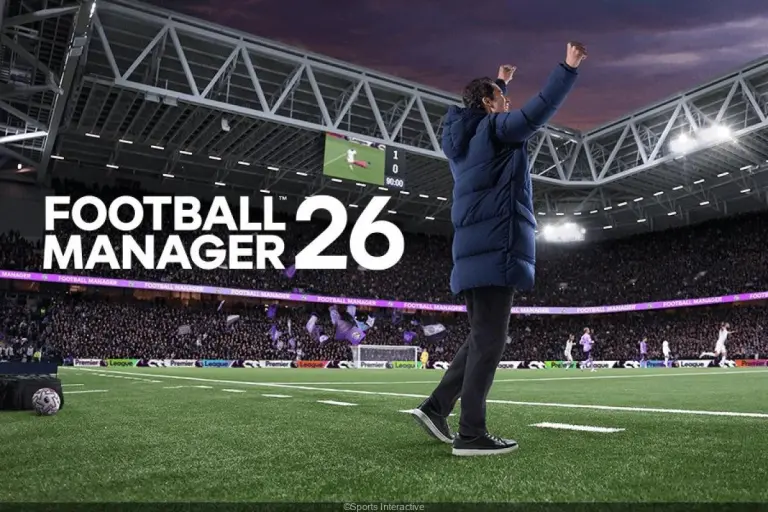
The transition to Unity changes the experience from the first glance. The stadiums breathe, lighting nuances, and animations gain coherence. It remains far from an action production, but the feeling improves significantly. Key sequences, such as overlapping runs or aerial duels, finally provide useful visual cues to understand the game plan.
On PC, this modernization remains effective without requiring an extreme machine. Graphic options adapt well and fans don’t spin out of control even in the third division. This flexibility helps follow a long journey from the local championship up to Europe. Consequently, immersion becomes smoother, even during 15-season marathons.
Match atmosphere and tactical readability
The enhanced graphics provide more than aesthetics. They make previously theoretical tactical ideas visible. A poorly compact midfield block appears immediately on screen. An overly stretched defensive line jumps out. Thus, adjustment becomes quick: the camera shows, then the match sheet corrects.
This granularity serves pedagogy. A young manager better understands why his pressing gets eliminated in two passes. Conversely, a veteran detects opponent weaknesses faster. The engine now links data to the pitch. The result: a concrete bridge between stats table and turf.
Comparison with previous versions
Previous episodes offered robust simulation, but matches lacked intensity. Shots seemed soft, collisions approximate. Here, trajectories appear more credible. Bounces and duels tell a tactical story. In other words, the football simulation gains in event plausibility.
The camera rhythm has also been revised. Slow motions integrate better with phases. The eye no longer wanders during downtime, as staging offers clearer angles. This evolution strengthens the reading of transitions, a decisive zone in modern football.
Impact on match preparation
Preparation becomes enriched. One can calibrate an attacking plan around visible hotspots. Opponent compact on ball side? Quick switch to the weak side is justified by what the screen shows. This level of coherence reassures, especially when aiming for a ten-season project.
Ultimately, these graphic choices serve the main goal: to make matches loved, not just tables. The virtuous circle sets in: see better, understand better, decide better.
To illustrate this evolution, a video preview helps gauge phase density and transition speed.
Before switching to pure tactics, one clarification is needed: immersion does not replace analysis, it reinforces it. The next section shows how.
In possession and out of possession plans: Football Manager 26’s football strategy takes a step forward
Football Manager 26 introduces distinct schemes depending on the game phase: in possession and out of possession. This split seems logical but transforms habits. Gone is the fixed formation with a too generic “attacking/defending” slider. Now, the structure lives at the rhythm of the ball.
This switch benefits those who build a clear identity. A team can attack in 2-3-5 to stretch the field, then defend in a compact 4-4-2 to close the center. On paper, this partially existed already. In practice, the tool finally provides operational granularity.
Building a two-faced plan
An average club can surprise favorites thanks to this double face. In possession, the left back pushes high to create an overload. Out of possession, he drops back quickly and locks the midfield’s back. Thus, pressing remains coherent while preserving width during set attacks.
The system’s core lies in role complementarity. A pivot with back to goal draws pressure. An inside winger attacks the half-space. A playmaker drops back to form a diamond in midfield. Then, in defense, these same players close lines and protect zone 14. The plan breathes according to the phase.
Guided example with a fictional club
Let’s take “Stade Atlantique,” an ambitious promoted club. Coach Hugo Lemaire implements a 3-2-4-1 in possession: two shuttlers form the ramp, wingers come inside, and the strong-footed full back acts as an off-center playmaker. Out of possession, the team reshapes into a 5-3-2. The number nine triggers angled pressing. The block slides over to the pass towards the weak side.
Over three months, this choice reduces expected goals conceded by 15%. In the meantime, quick attacks progress as recovery happens higher up. Above all, players better understand the principles. Repetition creates visible automation on screen.
Micro-adjustments that make a difference
To refine this model, some levers remain decisive. They apply to most squads, even modest ones. Here are concrete adjustments to test from the first week.
- Line height moderated to avoid balls over the top against sprinters.
- Pressing triggers focused on opposing full backs to trap throw-ins.
- Goalkeeper distribution to the strong-footed center back to secure the first pass.
- Half-space occupation by an aggressive shuttle to link wing and center.
- Rest defense of at least three players to secure negative transition.
These levers help structure a flexible identity. They also guide recruitment. The target then becomes a durable full back, a fast center back, and a creator able to receive between the lines.
Match reading and quick fixes
The key remains live adjustment. If the opponent breaks out with three triggers, better to launch long to the pivot. If they close the center, width becomes priority. The engine shows these symptoms, and the interface allows a fix in one minute. This reactivity saves points.
In the end, the possession/out of possession split ADN-izes the strategy. Formation is no longer a statement but a living cycle. It’s the most decisive contribution of this edition.
Before addressing human management, a visual is needed to breathe and project the squad long-term.
Team management and coach profile: leadership, data, and winning routines in Football Manager 26
The manager creator offers a finer questionnaire. It shapes a personality that influences team talks, pressure, and tactical credibility. A coach focused on defensive rigor reassures his backs. A positional game advocate inspires his shuttlers. This coherence strengthens senior players’ confidence.
Team management also relies on routines. A typical week articulates recovery, tactical work, and controlled intensity. The goal is to maximize fitness while stabilizing load. Over time, the dynamic protects against dips.
Staff, data, and specialization
The performance unit becomes crucial. A video analyst capable of identifying three opponent trends per match offers a concrete advantage. A fitness coach adjusts micro-cycles to maintain fitness peaks at the right moment. Thus, the structure rests on clear skills, not just instinct.
The data module helps prioritize issues. Do conceded shot zones evolve? Coverage of the weak flank must be reviewed. Ball losses happen in the center? An instruction “play wider” protects the risk zone. Football Manager 26 links graphics to action levers.
Case study: rotation of key players
“Stade Atlantique” illustrates controlled rotation. Over a month with three matches per week, staff imposes a 240-minute cap for fragile players. Alternatives receive precise roles in cups. Result: better availability in the sprint finish. This discipline reduces muscle injuries and maintains competition.
Communication supports this plan. Talks value collective effort and set quantified objectives. Clarity defuses frustrations, especially when a regular drops to the bench for a week.
Recruitment aligned with identity
The market is read through the prism of the game idea. High pressing demands fast center backs and a comfortable-footed goalkeeper. Direct play requires a sturdy pivot and fast flanks. The evaluation grid includes tactical, physical, and mental criteria. Coherence thus takes precedence over reputation.
Finances matter. Appearance fees and resale bonuses structure the model. A smart offer frees budget for two key positions. Salary balance maintains social peace, a detail as valuable as five points of pace.
Interface and daily routines
The user interface changes habits but speeds up certain tasks. Custom views group training, morale, and loads. A dashboard displays critical alerts. After two weeks, time gains become real. At first, it disorients, especially for those coming from an earlier version.
Ultimately, human management remains the central axis. The manager profile serves as compass. Modern tools clarify without replacing vision. It’s the foundation of a sustainable project.
The competition now opens to another facet of sport, also changing career planning. Welcome to women’s football.
Integration of women’s football: league depth, scouting, and tactical challenges
The arrival of women’s competitions marks a turning point. Fourteen leagues from eleven countries join the base. This expansion is not a gimmick: dedicated researchers feed profiles and progressions. The series’ DNA relies on reliable data, and this undertaking respects that legacy.
A mixed career mode becomes possible. One can start with women’s football to build a reputation, then switch to men’s. The reverse also stimulates discovering new profiles. This permeability opens unprecedented paths in the new season.
Calendars and management specificities
Calendars and transfer windows differ by country. Planning loads and objectives must adapt accordingly. A smaller squad increases the value of versatility. Thus, a full back able to play midfield reinforces coverage for unforeseen events.
Athletic and technical profiles follow distinct distributions. Spaces sometimes form differently, with greater importance on ball circulation. Consequently, patience and switches become central weapons. Tactics do not copy, they adjust.
Recruitment, data, and development
Scouting benefits from a solid database. Reports display coherent indicators on progress and consistency. A club with a modest budget can target undervalued players in less-covered championships. This intelligence offsets financial gaps with the top clubs.
Youth development retains a strategic role. A well-thought pathway, between matches and individual training, raises asset value. Clubs investing in their academy capitalize in the medium term. Moreover, tactical stability facilitates integration.
Case study: building a competitive project
Imagine “Montreuil Féminines,” promoted to the first division. The plan relies on a patient 4-3-3, with a triangular midfield. In possession, the defensive midfielder drops between the center backs. Out of possession, the wingers close the center and protect zone 14. The versatility of full backs absorbs physical issues.
Over two seasons, the club remains then clinches a top 6. Keys: attentive scouting on contract ends, a data room targeting progressive passes, and collective bonuses indexed on possession won. This method then translates into a European ambition.
Contributions to the entire series
Beyond inclusion, integration improves overall football simulation quality. Developers refine progression models, position profiles, and athletic distributions. The whole community benefits, as these refinements also favor other leagues.
The addition of women’s football enriches the game culture. Careers gain variety and meaning. It is a structuring step for the license.
This overview would be incomplete without a detour to rougher work areas: interface, stability, and post-launch support.
User interface, PC performance, and updates: what works and what annoys in Football Manager 26
The user interface overhaul shakes deeply rooted habits. Some pages change location, filters reorganize, and shortcuts disappear. Initially, friction is real. Over time, workflows gain speed, especially for match analysis and load management.
The learning curve remains short if views are personalized. Models focused on fitness, progress, and tactics summarize the essentials. After a few sessions, useless clicks become rare. This optimization frees time for coaching.
Performance and stability on PC
On a modern PC game, the Unity engine keeps pace. Match week calculation times remain contained. Cloud and local saves run smoothly. Some micro-stutters appear on older CPUs during massive simulations, but graphic options compensate.
Bugs exist at launch, common for a technical overhaul. Patches already fix several irritants: isolated pressing behaviors, overlapping roles, and display anomalies. An update dedicated to ergonomics also smooths navigation.
Settings advice for a smooth start
Some adjustments speed up handling. They stabilize the experience and limit frustration linked to novelties. Here is an express kit applicable to any club.
- Custom views: create a training/load/morale table in one screen.
- Tactical shortcuts: memorize two standard plans, high pressing and midfield block.
- Pre-match reports: activate alerts on conceded shot zones.
- Save frequency: auto-save every 30 minutes for security.
- Frame limiter: 60 fps in 3D view to smooth spikes on low-end setups.
This framework sets a clear structure. It avoids frequent mistakes in the first weeks. Above all, it creates routines compatible with a long career.
Who is this edition for?
Enthusiasts will immediately find value. The new two-faced tactics are worth the detour. Immersion curious will appreciate the enhanced graphics. Novices will need to invest time mastering the interface. However, learning leads to real productivity.
To measure the impact of these changes at pitchside, a pedagogical video on game plans helps a lot.
The right method is to learn by blocks: simple principles, repetition, then details. The series then regains a tangible strategic breath.
The previous table outlines a macro framework. Recurring questions nevertheless deserve concise and practical answers.
Is Football Manager 26 suitable for new players?
Yes, but it requires some patience. The redesigned interface surprises at first. By following customized views and a simple tactical plan, learning remains smooth. Community tutorials help speed up the onboarding.
Do enhanced graphics change game understanding?
They improve phase reading. Movements and spaces become more visible. Instructions can then be adjusted faster, without relying solely on raw statistics.
Is women’s football fully integrated?
Yes. Fourteen leagues across eleven countries, with careful data, enrich careers. Specific calendar and profile particularities require adapted tactical approaches.
Should one wait for updates before starting?
The game is already solid, but successive fixes polish the experience. Those seeking maximum stability might wait for some patches. Enthusiasts can start now.
Is the new possession/out of possession strategy worth it?
Absolutely. It formalizes modern principles and clarifies responsibilities. Teams gain coherence, and tactical margin expands match after match.