
| Key points to remember |
|---|
| FM26 receives the version 26.1.3 on Steam, Epic, and Microsoft Store. |
| Expected feature return: reintroduction of pass maps during matches and in the Data Hub. |
| AI adjustments to the match engine: more coherent pressing, refined defensive decisions. |
| Targeted stability fixes: specific crash eliminated and increased save reliability. |
| Performance optimization: smoother load times and improved interface responsiveness. |
| No tactical upheaval, but a clear gain in readability and control. |
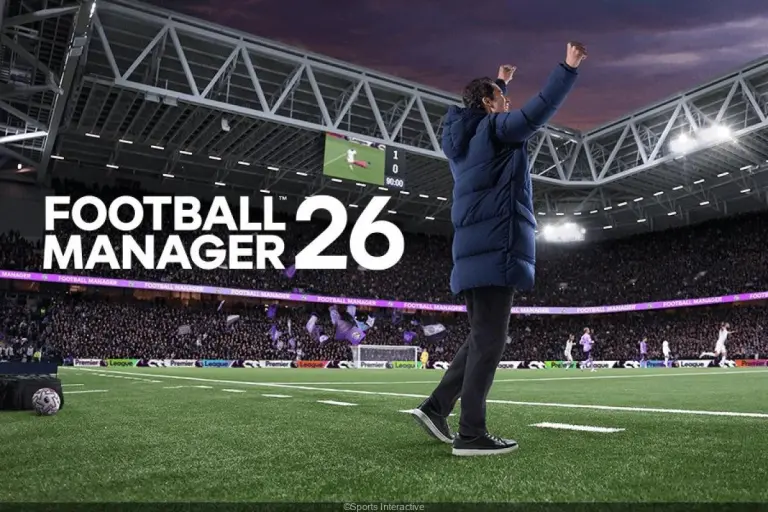
By deploying the Update for FM26 numbered version 26.1.3, Sports Interactive favors precision over excess. The studio brings back a much-praised analysis brick, the pass maps, while fine-tuning the match engine with targeted AI adjustments focusing on pressing, information gathering, and clean defensive interventions. Altogether, it comes with stability fixes and technical optimization that smooth the experience, especially in long careers and on entry-level devices.
Without revolutionizing habits, this feature return and these tweaks add depth to tactical readings, from the sidelines to the Data Hub. Virtual coaches gain tangible visual cues, while the artificial intelligence better avoids extremes seen after 26.1.2. The result is visible in both ball circulation paths and goalkeeper sorties and line pacing—a sign of a patch designed to solidify without freezing.
FM26 update v26.1.3: return of pass maps and concrete changes for analysis
The restoration of pass maps in version 26.1.3 marks a strategic shift: giving players back an exploration tool that crosses volume, direction, and zones of influence. In FM26, these views appear at two key moments: live during the match and afterward via the Data Hub. Thus, ball circulation is no longer an impression, but a measurable distribution by corridors, thirds of the pitch, and relay heights.
On the virtual bench, coaches can finally observe if the short relay hooks up with the right pivot or if the right inside consistently cuts the passing lane to the false nine. However, the interest is not limited to attack: the density of interceptions on a wing often reveals an opposing overload or structural weakness. From there, adjusting a winger’s role from support to attack can unlock a buried diagonal.
Why this visualization changes match preparation
Connection graphs emphasize pattern repetition. In practice, the eye quickly spots a too-flat left lateral triangle, or an overused number ten axis that attracts pressing. Moreover, a funnel of passes toward a timid full-back alerts about a lack of switching, encouraging a more active half-space via a mezzala or an inverted full-back.
Concretely, three uses impose themselves. In preparation, identify the opponent’s strong chains to trap their buildup. At halftime, recalibrate the height of a defensive midfielder who never receives oriented forward. After the match, segment by period to link fatigue and passing choices, a valuable indicator for squad rotation.
Case study: correcting a right-side funnel
Facing a 4-4-2 midfield block, a typical “Atlantique FC” showed a transmission overconcentration between right CB and right full-back, without interior relay. Thus, the map revealed a bottleneck attracting the opponent’s clamp. By switching the right midfielder from winger support to inside forward, while instructing the full-back to underlap, the next map traced a diagonal toward the half-space, then a vertical pass to the striker.
Result: fewer losses on the line and more touches between the lines. Furthermore, the opponent’s pressing lost its landmarks, forced to widen the clamp. The visualization facilitated iteration: the center-forward dropped two meters less deep but received with an open body, accelerating the first-time shot.
- Spot possession nodes that stagnate and break symmetry.
- Check body orientation via the frequency of forward passes.
- Test a planned wing inversion for 10 minutes and compare patterns.
- Correlate the map to the heat of recoveries to shut the tap at the source.
The best indicator remains the evolution of destination variety over 15 minutes. If the map diversifies its arrows without loss of accuracy, the tactical change hit its target. In this logic, the Update strengthens the digital staff’s decision autonomy.
FM26 26.1.3: AI adjustments to the match engine and clearer behaviors
The heart of the patch lies in the AI adjustments that influence reactions, pressing, and timing. In version 26.1.3, the artificial intelligence better modulates collective pressure based on the number-speed ratio. Thus, full-backs no longer systematically abandon the far post on a quick switch, while midfielders step back half a pace to close the axis before impact.
Center-backs better manage the confrontation line. Conversely, they do not preempt inappropriately on an undecided ball, limiting air gaps. Yet, aggression does not decrease: it adjusts to context, with a delayed tackle when support arrives, rather than a useless dive.
Coherent pressing, tightened lines, and protected angles
Coordinated pressing sometimes felt binary after 26.1.2. Now, the lateral pressing pint triggers on finer signals: back to goal reception, weak foot, or poorly oriented passer. Moreover, the opposite winger better keeps width to counter game switches, reducing 2v1s at the far post.
On set pieces, marking cues see slight smoothing. Thus, near-post drops no longer disrupt the entire zone. In play, the body angle of the number six before passing to a center-back is protected, preventing unrealistic interceptions in the axis.
When the block steps up, defensive transition better paces coverage. Besides, full-backs adjust their recovery speed to the actual depth of the threat, not an overly pessimistic estimate. This grading reduces unnecessary runs and keeps clarity for the final action.
Goalkeepers, sorties, and animations fixed with restraint
Goalkeepers gain credibility on lob trajectories. Also, rushed sorties into blind spots happen less frequently, improving reading on driven crosses. The opposite hand appears at the right moment on mid-height shots, with a sharper animation.
On the opponent AI side, game plan changes are less spasmodic. Thus, a virtual coach no longer abandons its 4-3-3 too early for a 3-5-2 without a tangible trigger. This continuity offers the human player stable cues and avoids a tactical ping-pong effect.
The overall effect boils down to one sentence: a match easier to read and influence. In this context, coaches save time on analysis and focus on the comparative advantage, not on chaos correction.
Stability fixes and optimization: what the patch changes over time
The Update version 26.1.3 targets a crash linked to Siege mode and specific calendar interactions. Concretely, the sequence freezing certain saves no longer survives the fix. Thus, very advanced careers better survive season ends, including on extended databases.
Beyond the crash, several memory leaks were patched. Additionally, the interface responds faster during dialog box sequences, avoiding unintended double clicks. On modest machines, cumulative gains make navigation smoother between mailbox, tactics, and staff assignment.
Loading, consoles, and patch rollout
Deployment happens automatically via Steam, Epic, and Microsoft Store. However, in case of blockage, an integrity check and client restart solve most cases. The official guide remains accessible on the SEGA base: FM26 – How to install and update.
On consoles, the benefit is felt mainly in menu back-and-forths and wake-from-sleep. Furthermore, save times gain a few seconds on large matches. Overall, the optimization reduces mental wear in long sessions.
Save reliability and schedule peace of mind
Compressed match run simulations no longer drift toward abnormal behaviors. Thus, international scheduling and weather postponements do not cause duplicate events. Yet, the calendar remains demanding and forces rotation, which is sports logic.
The indirect benefit is clear: confidence rises, and everyone dares to push experimental careers without fearing a fatal crash at the worst moment. In short, stability fixes free play intent and foster tactical creativity, especially when multiplying parallel saves.
Data Hub: exploiting new pass maps for lasting advantage
The FM26 Data Hub regains visual coherence with the feature return of pass maps. Filters now allow views by quarter-hours, player combinations, or only on transitions. Thus, a team can isolate circuits leading to a chance, rather than adding everything indiscriminately.
The key lies in the judicious stacking of reports. Moreover, overlaying the pass map with recovery heatmaps and shooting zones offers quick correlations. From there, decision-making gains clarity: reinforce what creates quality shots, correct what dilutes advantage.
Pragmatic reading and operational decisions
A help table can save time in staff meetings. Concretely, it links an observation to a precise action so an assistant can implement the adjustment during the match. This discipline avoids vague exchanges and sets a clear roadmap.
| Pass map observation | Tactical hypothesis | Recommended action |
|---|---|---|
| Right full-back → right winger connections saturated | Corridor lock-in, lack of switching | Invert the winger, ask full-back to underlap |
| Few passes forward from the six | Unfavorable body orientation, axial pressing | Trigger ten’s drop, offer back-to-play support |
| Strong diagonals on left side, sterile right side | Exploitable structural imbalance | Switch to strong side, attack far post |
| Central relay constantly cut | Narrow opponent block, telegraphed passing lane | Use wide relays, fix then switch |
The discussion does not stop at the “what,” it touches the “when.” For example, choosing a 10-minute slot to test underlap just after opponent coaching has more chances to surprise. Consequently, response is measured by arrow widening and variation in entries into the box.
In the medium term, staff can automate three recurring scenarios. First, trigger a quick inversion at the 30th minute if the map shows a funnel. Second, increase width late in the match if directional variety collapses. Third, lower passing risk for a targeted defender if two consecutive losses appear on the same axis.
Evaluating version 26.1.3: simple test protocol to measure real impact
Measuring the effect of an Update requires a method. Thus, a five-step protocol helps objectify sensations and avoid hasty judgments. The fictional team “Atlantique FC” serves as a guide to illustrate the approach, reproducible in any division.
Step 1: define a stable eleven and tactic over three matches. Then, note three primary indicators: successful progressive passes, chances created, and xG conceded. Also, capture pass maps by half to build a clear before/after.
Steps 2 to 5: from measurements to decision
Step 2: introduce a single change inspired by observed AI adjustments, for example pressing height or six’s orientation angle. Step 3: replicate three matches in similar contexts to smooth variance. Then, compare maps and overall accuracy.
Step 4: if the effect is positive, standardize by creating a plan B, then test against more varied AI. Finally, Step 5: validate in official competition and record results to feed the optimization cycle. This framework capitalizes on the more predictable artificial intelligence of version 26.1.3.
Some numeric benchmarks help decide. If progressive passes increase by 10% with stable accuracy, the approach is good. Conversely, if directional variety expands but xG does not evolve, move the attack point rather than insist in the same area.
This protocol has a merit: turning a feeling into a signal, then a signal into a concrete decision. Ultimately, tactical reading gains reliability, and the team keeps a compass even when the opponent changes shape mid-match.
How to activate pass maps after the update ?
They are available live via the Match Analysis tab and in the Data Hub, Passes section. Use the filters by period or by player for precise diagnosis.
Do AI adjustments change my existing tactics ?
No, version 26.1.3 does not disrupt cues. It mainly makes pressing and defensive decisions more coherent, clarifying reading without requiring an overhaul.
What stability fixes are included ?
A crash linked to Siege mode was fixed and memory optimizations improve save reliability. The interface also responds faster during rapid navigation.
Does the update install automatically ?
Yes, on Steam, Epic, and Microsoft Store. In case of failure, check file integrity and restart the client. A guide is available via SEGA support.
What practical gains to expect in match ?
Better-triggered pressing, fewer isolated defensive errors, more credible goalkeepers, and refined tactical reading thanks to reintroduced pass maps.