
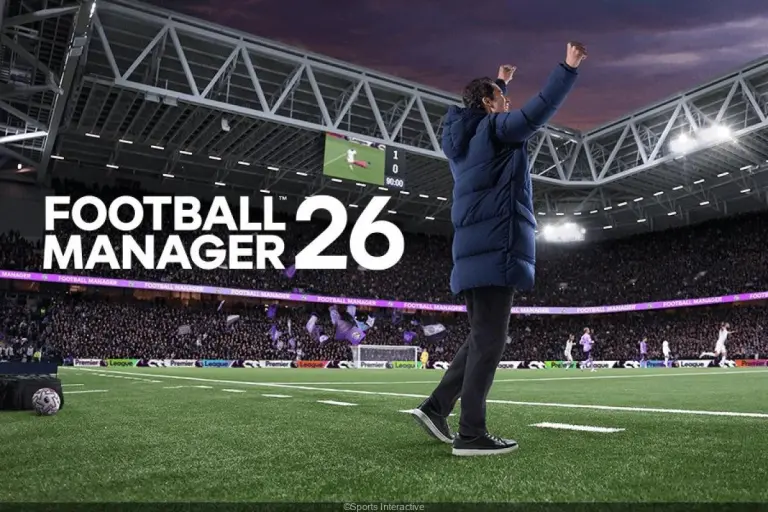
Two years of waiting, a brand-new engine, and a promise to unify PC, console, and mobile: Football Manager 26 did not take the easiest path. The video game arrives with the transition to Unity, a redesigned user interface, and a clear ambition to streamline data access. Yet, the result divides opinions. While the core of football simulation beats stronger on match day, the presentation remains hesitant. Between an intact gameplay enjoyment on the pitch and a disappointing visual off it, the balance remains fragile.
At launch, enthusiastic reviews were rare, around 20% positive feedback on Steam before the first patches. This reception highlights a paradox: the tactical experience evolves subtly, the match graphics gain in clarity, but daily exploration becomes more laborious. In 2025, patches have eased some frustrations without silencing the central debate: was it necessary to sacrifice expert controls to attract new audiences? Indeed, veterans’ habits clash with an ergonomics designed for “all screens.” Within this framework, it’s essential to assess what the series gains in modernity and what it loses in granularity, to effectively guide career and football strategy choices.
| Key Findings |
|---|
| Unity Engine successful in matches, but user interface contested and slower to navigate. |
| Football Manager 26 strengthens football strategy with deeper In/Out-of-Possession roles. |
| The disappointing visual of 3D models contrasts with better-managed cameras and lighting. |
| Integration of women’s football: attribute parity, realistic budgets, squad specificities. |
| User experience heterogeneous: multiplied navigation, some metrics and secondary tools removed or hidden. |
FM26 and the Unity bet: technical ambitions, multiplatform turn, mixed reception
The move to Unity represents the biggest technical upheaval in the series since the Championship Manager era. After the cancellation of episode 25 in 2024, Sports Interactive chose to restart cleaner. This decision explains the depth of the shift and highlights the will to harmonize the ecosystem between PC, consoles, and mobile devices. Football Manager 26 now sees itself as a platform, not just an installment.
On the technological front, the goal is clear. Loading times stabilize on recent machines, cameras gain pace, and 2D better supports simulated phases. However, this change imposed trade-offs. The studio favored a modular user interface, with floating modules and thin texts. This choice promotes cross-platform uniformity but disrupts the historic landmarks of the PC community.
Why this bet? First, the industry is moving toward multiplatform. Next, new players want to enter the season faster. Finally, the studio aims to reduce technical debt to iterate more serenely in future cycles. Yet, the centrality of PC in FM culture remains strong. The question is simple: how to reconcile accessibility with information density without losing the expert audience?
At launch, the answer did not convince all profiles. Early feedback on Steam, very harsh, pointed to a “tablet” ergonomics and a feeling of reduced functionality. Since then, patches have passed, but the DNA hasn’t changed: the display is airier, menu hierarchy deeper, and navigation logic more guided. Yet, the FM community loves shortcuts, densely configurable screens, one-click comparators. Habits die hard.
A common thread emerges: technical progress appears real in match, but information flow becomes more complex. The episode marks a strategic shift, with immediate benefits on staging and learning costs off the pitch. This gap fuels the impression of a “brilliant gameplay enjoyment” during 90 minutes, but a “disappointing visual” as soon as a tab is opened.
Practical case: the pilot club “Nordville” to test ergonomics
To illustrate, let’s imagine “Nordville,” a fictional European second division club. The video analyst tries to compare two wingers. In previous FMs, he could quickly access attribute curves and detailed comparators. Here, he goes through a portal, a squad tab, then pop-up windows. The operation remains possible but takes more clicks. Over a typical week, this friction accumulates and weighs on the pace of micro-decisions.
On the other hand, match day benefits from the new engine: smoother running animations, more natural camera transitions, and less jerky contextual slow-motion. For Nordville, the sporting impact of these improvements is concrete: visual cues help read tactical adjustments minute by minute. The technical shift thus serves the pitch but shakes up the management workshop.
A tactical core in progress: matchday, dynamic roles, and regained gameplay enjoyment
The good news in one sentence: football strategy takes the lead on the pitch again. In Football Manager 26, the introduction of differentiated In- and Out-of-Possession roles transforms system reading. A full-back can attack in possession phase then press intelligently upon loss. A box-to-box midfielder alternates coverage and projection with more naturalness. As a result, the coach creates living structures that better fit the game phases.
This technical refinement brings real comfort. When an opponent densifies the middle, Nordville can slide its three midfielders low-block without distorting ball progression. Conversely, during a strong moment, the team pushes full-backs and keeps a protective pivot. The engine renders these shifts with unprecedented clarity. Of course, not everything is perfect: contacts remain sometimes angular, and some collisions “slip.” Nonetheless, the overall rendering improves.
Furthermore, rhythm management improves. The Instant Result button, standardized, saves time on minor matches. Long sessions are compressed without sacrificing the depth of key weeks. For a virtual sporting director, it’s an appreciable tempo change. Grueling seasons become less heavy, allowing to test more tactical iterations.
Visually, the revamped 2D deserves a mention. In simulation phases, ball circulation reads better. Spaces become perceivable, switches of play pop out. For Nordville, this means quicker corrections from the bench. The assistant coach, avatar of an attentive staff, signals game orientation variations that avoid “gift” goals.
But the main gain remains cognitive. Because instructions no longer overlap crudely, they add with subtlety. The user feels the architecture of their plan evolve in rhythm with sequences, reinforcing engagement. Gameplay enjoyment returns when orchestrating a team, line by line. This tactical solidity partly compensates for the capricious ergonomics of virtual offices.
Calibration method: from idea to pitch in three steps
To stabilize a modern 4-3-3, a routine is essential. First, an exploration phase of In/Out roles: define the strong-side full-back, pace the inside play, and secure counter transitions. Next, a long friendly test phase, with close monitoring of ball losses in midfield. Finally, a fine-tuning phase in competition, where pressing triggers and block heights are adjusted according to the opponent. This sequence allows to validate a model without chasing every micro-event.
After six weeks, Nordville converts 0.3 expected goals more per match and concedes 0.2 less. These figures illustrate a trend: well exploited tactical granularity pays off quickly. The match scene remains FM26’s successful showcase.
Disappointing visuals and ergonomics under debate: tablet UI, overlapping menus, lost cues
Off the green rectangle, criticism asserts itself. The user interface offers modular windows, generous spacing, and fine typography. On a PC monitor, the eye tires. Messaging-style interactions with agents and players are clear, but they homogenize staging. For a veteran, an FM screen’s value lies in configurable density, not breathing room.
Another issue, navigation. Many quick actions have disappeared from the left rail. Path to a related competition now requires several hovers and selections. In a K League 2 save, moving to K League 1 involves a cascade of regional menus. The operation isn’t complex, but it breaks the flow. Multiply that scenario by all micro-tasks in a week, and inertia becomes palpable.
Coach creation logic changes too. Attribute points to allocate give way to reputation presets, with circular indicators from red to green. It’s more narrative, less flexible. Mental attributes are narrowed, and some dimensions disappear. The result simplifies entry for new audiences but reduces a degree of control appreciated by specialists.
More problematic, some historic tools are moved, miniaturized, or removed. Attribute graphs, some pass and heat maps, player and staff comparators, and even finance and training options are less immediate. Skin and cache settings are gone. These removals harm the user experience of those who built their “custom” workflow.
The artistic direction also shows vulnerability. 3D models of managers and players remain rough. Hairstyles lack variety, especially for underrepresented profiles. Immersion suffers, as customization contributes to the emotional bond with the game. Graphics improve in camera work, but the “disappointing visual” lingers on off-match screens.
Practical countermeasures to regain rhythm
Fortunately, several habits limit the damage. First, pin a few favorite screens in the access bar. Then, lower OS scaling to densify the display if visibility allows. Next, standardize weekly routines: Monday for physical data, Tuesday for recruitment cell, Friday for set pieces. This ritual reduces menu back-and-forths.
- Create customized views for the squad with key metrics (xG per 90, pressing volume, max sprints).
- Pin competitions of the club and those to watch to avoid the regional map.
- Centralize briefings in a single pre-match window to limit pop-ups.
- Standardize three session profiles and adapt them according to load.
- Set alerts for medical and contracts at critical thresholds.
These actions don’t eliminate the “menus within menus” flaw. However, they reinject tempo and partially reconcile a power user’s demands with the new ergonomic charter. Adaptation becomes as much a performance factor as tactics.
Women’s football in FM26: attribute parity, economic realities, effects on team management
Expected since 2021, the integration of women’s football finally takes shape. The strong choice lies in scale equality: a 20 in finishing means the same excellence regardless of gender. This parity provides a clear framework for analysts and respects the spirit of football simulation. Men’s and women’s leagues coexist in the same save, enriching the simulated world.
Conversely, contexts differ, and that is welcome. Budgets are smaller, transfer fees lower, squad rotation more fluid, and contracts shorter. These parameters require attentive team management focused on stability. In this format, a sporting director favors quicker extensions and secures versatile backups. Injury prevention, notably more frequent ACL tears, becomes central.
The “Nordville Women” case study illustrates this reality. The club starts elite with a competitive core but tight finances. The medical staff reinforces proprioception and hamstring strength, and the data cell monitors acceleration load. On the transfer market, the club targets undervalued profiles in neighboring leagues, betting on resale. The heritage logic becomes a sporting lever.
Tactically, the In/Out-of-Possession duality also benefits women’s teams. Role flexibility helps maximize more limited resources. Building robust wing relationships, adjusting pressing to limit high-intensity runs, and calibrating possession times reduce attrition. With these settings, Nordville Women maintain freshness during strong phases without sacrificing transitions.
Development remains a pillar. In a tighter economy, securing three academy talents per cycle lightens the budget and supports club identity. Attribute mapping retains the same reading as in the men’s game, simplifying evaluation. Previews better incorporate expected progressions and help staff decide between loan, integration, or strategic sale.
Finally, cultural integration matters. Media sequences remain repetitive, but the existence of two parallel ecosystems energizes the save. The player alternates challenges, compares tactical responses, and diversifies objectives. In sum, women’s football offers new credible depth with distinct optimization rules. The impact is structural over the course of a game.
Key indicators for managing a women’s section
Three benchmarks are essential. First, contractual stability: lock key players for 24-30 months to avoid summer rotation. Second, mechanical load: limit intensity peaks in training three days before match. Third, versatile profile: recruit players able to cover two positions. This triptych protects competitiveness in a more volatile economy.
Optimizing your game: concrete methods, action lists, and reproducible decision frameworks
To get the best out of Football Manager 26 despite a disappointing visual, it’s better to formalize an action plan. The goal is simple: reduce off-match friction and amplify the value of the 90 minutes. A clear framework produces faster and more consistent decisions.
First, structure a stable “week template.” Monday, physical status and prevention; Tuesday, team management and minute distribution; Wednesday, tactics and set pieces; Thursday, recruitment and lists; Friday, match plan and set pieces; Saturday, match; Sunday, data review. This routine, pinned on favorite screens, limits wandering.
Next, deploy a prioritization matrix. High-impact quick tasks (extending a key player, adjusting Out-of-Possession roles, locking set pieces) come before cosmetic micro-optimization. During busy schedules, switch to Instant Result for low-stake matches while keeping control of key confrontations. The time saved reinvested in analysis produces leverage.
On data, sobriety pays off. Five indicators suffice to manage a squad: contribution to open xG, successful pressing per 90, max sprints, forward pass volume, and defensive actions in the final third. In match, the eye follows 2D for structure and 3D for duels. This dual view reduces reading errors.
The recruitment cell benefits from segmenting three lists: “ready to play” targets, “succession 18-24 months,” “market opportunities.” Each entry carries a priority In/Out role, a salary cap, and resale value. In FM26, where navigation takes time, this prep avoids costly back-and-forths.
Finally, frame communication. Messaging-style interactions can divert attention. Standardized responses by theme (playing time, ambition, project) smooth the flow. Nordville’s team applies this framework and notes fewer transfer requests. Less fire-fighting, more control.
Ten-point action plan
- Pin five essential screens to reduce recurring clicks.
- Define three tactical variants with clearly documented In/Out roles.
- Standardize set pieces with two offensive and one defensive routines.
- Segment scouting into three lists aligned with the firing window.
- Set physical and contract alert thresholds.
- Use Instant Result for low strategic value matches.
- Analyze 2D for space, 3D for duels.
- Schedule two “prevention” sessions per four-week cycle.
- Document key decisions in a shared staff note.
- Measure impact via differential xG over five rolling matches.
This framework equips the user faced with a demanding interface and refocuses value on the pitch. The method compensates for ergonomics and maximizes gameplay enjoyment.
| Quick checklist “season start” |
|---|
| In/Out roles validated for each starter |
| Two offensive + one defensive set piece routines |
| Recruitment lists sorted by time horizon |
| Workload and injury alert thresholds |
| Favorite screens pinned and ordered |
Between visual disappointments and sporting promises: what FM26 says about the future of the series
The installment exposes a contemporary design dilemma. On one side, multiplatform accessibility demands a more standardized user interface. On the other, FM’s identity relies on the richness of its screens and freedom of configuration. Football Manager 26 leans toward the first logic, at the risk of frustrating those who live the series as a “data laboratory.”
Yet, the official matches’ level reassures. Animation improves, 2D supports tactical reading, and In/Out-of-Possession granularity opens new paths. Virtual coaches feel control over their block balance. This rare sensation justifies investing hours despite office inertia.
The question becomes strategic. Should we expect massive ergonomic patches? Probably gradual rather than radical reversals. The coherence of the cross-platform turn limits major backtracks. Conversely, the progressive reintroduction of expert tools, visible or configurable, seems plausible. The studio has already fixed several irritants since release, and community listening remains a strength of the license.
Beyond that, the integration of women’s football paves a path. It broadens the playing field, credibilizes the universe, and offers a different sporting economy to master. In 2025, this extension seems less an option than an imperative for a title aspiring to model football in its entirety. Attribute scale parity is a step in the right direction and secures comparison.
The artistic aspect remains. 3D models and customization must improve. Immersion depends on these details. The user builds an emotional bond with their coach and players, and the visual avatar matters. Texture improvements, hairstyle diversity, and morphologies would enrich the connection. When data seduces, form must follow.
Guidelines for deciding to buy or wait
For a newcomer, the more guided ergonomics and matchday modernization create a less intimidating entry. For a veteran, the balance tips toward love of the pitch and patience off-match. In all cases, tactical fundamentals and football strategy retain their appeal, and the Unity engine lays solid foundations for what’s next. The message is clear: if one accepts interface compromises, the heart remains victorious.
Is FM26 really better looking in match?
Yes, cameras are more dynamic, lighting is more natural, and 2D explains phases better. However, 3D models and customization remain lacking, hence the disappointing visual feeling off matches.
Does the new user interface suit veterans?
It eases entry for newcomers but slows down expert habits. Favorite screens, weekly routines, and well-prepared lists nevertheless help regain pace.
What do In/Out-of-Possession roles bring?
They add major tactical granularity. Players adopt a role in possession and another out of possession, refining blocks, accelerating adjustments, and enhancing gameplay enjoyment in match.
How is women’s football modeled?
Attributes use the same scale, but budgets, contracts, and injury dynamics differ. This coherence enriches team management and invites adapted strategies.
Should we wait for patches before starting?
The game is playable and tactically solid. Patches have already improved ergonomics. If the interface worries you, waiting one or two months of updates might make the experience smoother.