
In Brief
- The 2026 FIFA World Cup takes place in three host countries: United States, Canada, and Mexico.
- The tournament expands to 48 teams, significantly broadening the field of playable national teams and “outsider” paths.
- FIFA states that 1,248 players will participate in the final phase, based on the submitted final lists.
- In Football Manager 2026, international management gains interest with more structured preparation, broader monitoring, and finer team management over a short period.
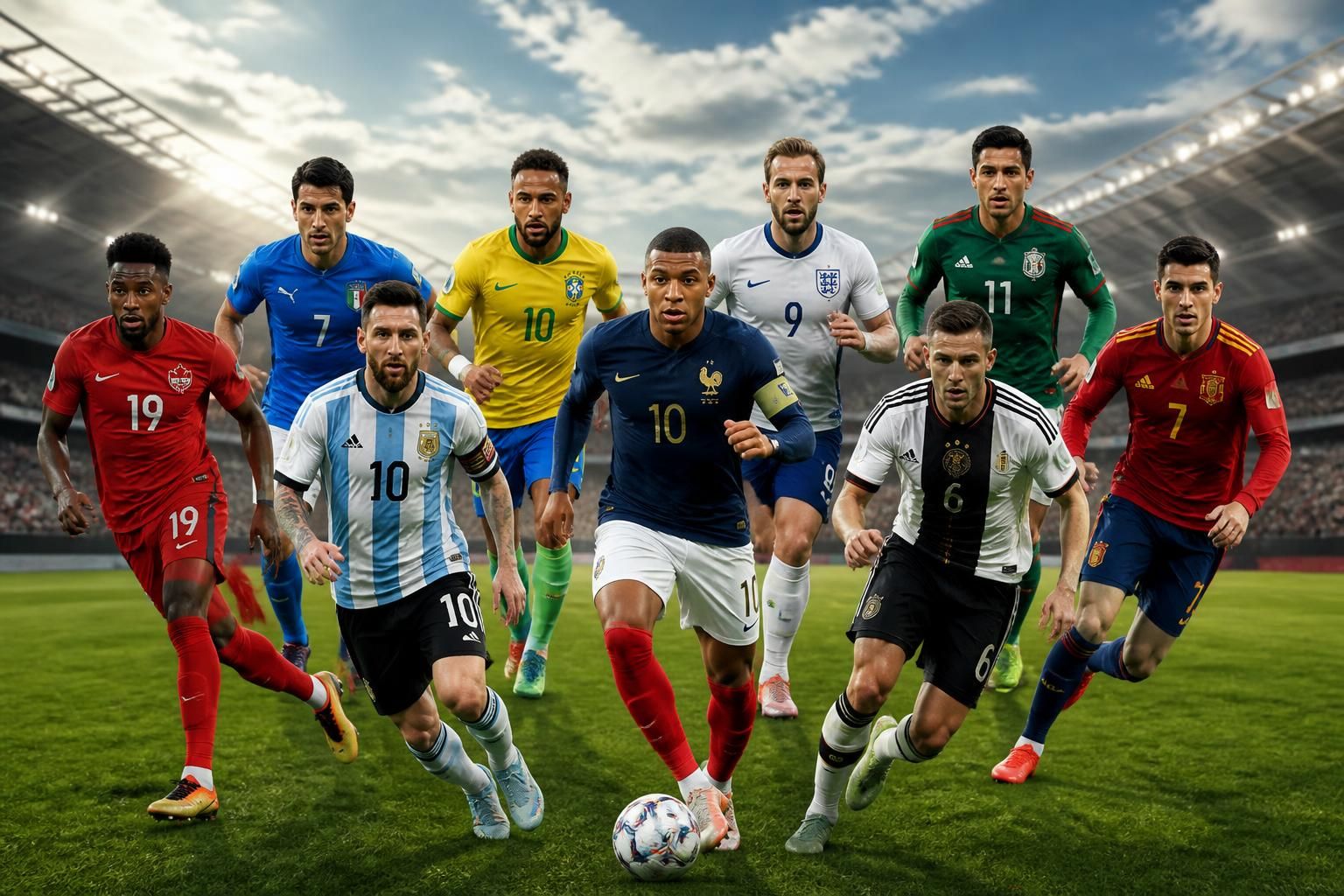
- Nine squads stand out to vary the challenges: favorites to uphold, rebuilding, golden generation, or historic qualification to turn into an epic.
The format of the 2026 FIFA World Cup changes the game: 48 teams, three host countries (United States, Canada, Mexico), and an unprecedented number of players mobilized. FIFA specifies, on its page dedicated to final lists, that a record 1,248 players will participate in the final phase based on the submitted lists. In Football Manager 2026, this context pushes to rethink habits: preparation time is short, cohesion must be built quickly, and football strategy often plays out on concrete details, like the ability to impose clear principles in three gatherings.
The interest, in FM26, also comes from the contrast between squads: some have depth in every line and impose a team management logic focused on rotation and freshness; others require compensating for a lack of talent with pragmatic football tactics and opportunistic player recruitment via dual nationality and current form. This selection of nine teams targets complementary profiles, with a common thread: World Cup Preparation depends as much on the clarity of the game plan as on the selection of roles, and not just on stacking the best names.
2026 FIFA World Cup and Football Manager 2026: What the New Format Changes in International Management
With 48 teams, the final phase opens more “realistic” trajectories for nations less accustomed to the round of 16. The direct consequence, on the FM26 advice side, is pressure management: the goal is no longer just to “participate,” as the achievable level moves up a notch for strong groups.
The constraint remains the same: few sessions, few automatisms, and players arriving with variable workloads. The manager must therefore build a simplified, readable, and repeatable football strategy, rather than a club model based on weeks of training. A clear plan A, a coherent plan B, and well-rehearsed set pieces become points of immediate yield.
Levers That Save Time in World Cup Preparation
The first priority is to lock down a hierarchy of positions with stable roles. In an international tournament, permanent rotations cost more than in a club season because they blur defensive markers.
The second lever concerns standards: a well-calibrated organization on corners and free kicks yields “free” goals over a month of competition. Finally, status management (leaders, starters, impactful subs) must be decided early to avoid frustrations in a tight group.
Comparison Table: 9 National Teams to Manage in FM26 for the World Cup
The table below targets concrete criteria useful in team management: depth of pool, clarity of playing identity, scope for progression over the tournament cycle, and rotation difficulty. The idea is not to “rank” nations, but to indicate what really changes a game in Football Manager 2026.
| National Team | Result Expectation Level | Bench Depth (1-5) | Tactical Flexibility (1-5) | Fatigue/Injury Risk (1-5) |
|---|---|---|---|---|
| France | Very High | 5 | 4 | 3 |
| Argentina | Very High | 4 | 4 | 3 |
| England | High | 5 | 4 | 4 |
| Morocco | Intermediate | 3 | 4 | 3 |
| United States | Intermediate (host) | 3 | 4 | 3 |
| Canada | Intermediate (host) | 2 | 3 | 4 |
| Mexico | High (host) | 3 | 3 | 3 |
| Japan | Intermediate | 3 | 5 | 2 |
| Senegal | Intermediate | 3 | 3 | 3 |
France: The Complete Team to Aim for the Title and Test a Dominant Football Strategy
In FM26, France offers rare comfort: two international-level players per position, simplifying rotation and allowing for an ambitious game plan without collapsing at the first physical mishap. The difficulty lies elsewhere: internal and media pressure demands very strict ego and minutes management.
The most effective scenario is to build a stable defensive base, then free the attack with aggressive flanks. Preparation focused on pressing and quick transition often yields immediate results because athletic quality allows for higher intensity than average.
FM26 Advice: Secure the Dressing Room Without Restricting the Stars
A rich group pushes to make quick choices about hierarchy, especially at goalkeeper and central positions. Players accept a announced rotation better than an improvised alternation after a bad match.
To avoid tensions, communication must be short and coherent: defined status, defined role, and “promised” minutes held on manageable matches. The tournament is short; a leader’s memory is even shorter.
Argentina: Managing Pressure and Winning by Details in an International Tournament
Argentina plays well as a squad because the competitive DNA transfers easily: compact block, controlled aggression, and exploitation of strong phases. In Football Manager 2026, the key is to avoid the trap of sterile control if the team lacks midfield cohesion.
A pragmatic plan — quick recovery, vertical transitions, and prioritized set pieces — fits the reality of a knockout competition, where tight matches are often decided by a set-piece action.
England: Maximum Depth, but Delicate Team Management on Rotation
The English pool facilitates recruitment of “occasional” players: versatile profiles, fullbacks capable of hybrid roles, and offensive options from the bench. The risk, in FM26, comes from an overload of talent that leads to overthinking tactics.
An effective approach is to fix a starting XI and plan two to three rotations depending on the opponent, not mood. Defensive coherence becomes the barometer, especially if fullbacks push high.
Morocco: Cohesion, Transitions, and Managing Low Phases
Morocco is a solid choice for those seeking a balanced challenge: a credible defensive base, dangerous flanks, and a collective that values simple principles. In an international tournament, the team can win without dominating possession, provided low phases are managed.
The typical game plan relies on a midfield block, quick breaks, and strict discipline. Adjustments are made more on tasks (support/attack) than on a complete system change.
United States: Taking Advantage of Host Context and Building a Clear Identity
With a home tournament, the FM26 reading is simple: the sporting goal comes with pressure for results. Success depends on an assumed playing identity, as the squad may lack landmarks if the plan changes too much between matches.
A modern football strategy based on intensity and quick projection works well if defense remains compact. Versatile profiles become valuable, especially to cover two positions on the final list.
Canada: The Bet on a Solid Block and Sharp Transitions
Canada is a “management” choice in the good sense: less depth, thus clear decisions, and a stronger dependence on the form of few key players. In FM26, the difficulty is limiting games where the team suffers too long without breaking out.
A compact 4-4-2 or 4-2-3-1 structure, with quick breaks on the wings, helps maintain a constant threat. Preparation must include a plan for set pieces, as that’s often where the gap against stronger teams is created.
Mexico: Managing Public Expectation and Stabilizing Defense
Mexico, as a host country, plays with marked psychological constraints. FM26 often highlights this parameter through group dynamics and reactions when results delay. The team can produce football, but defensive stability decides the path.
A 4-3-3 or 4-2-3-1 framework, with hardworking midfielders and disciplined wingers, avoids “crazy” matches that turn around. The choice of goalkeeper and central defense must be conservative, even if offensive temptation is strong.
Japan: The Most Flexible Football Tactics Option to Surprise
Japan is an ideal team to test demanding football tactics: coordinated pressing, clean ball exits, rotations on the sides. The team handles structural adjustments well, allowing a specific plan depending on the opponent without losing the backbone.
In Football Manager 2026, a 4-3-3 modifiable in defensive phase offers a good compromise. The margin comes from the quality of build-up circuits and efficiency in the box, often decisive in a short tournament.
Senegal: Power, Verticality, and Risk Arbitration
Senegal lends itself to a direct approach, with high intensity and rapid search for depth. In FM26, the challenge is to maintain balance: pushing too high exposes defense, staying too low cancels striking qualities.
The best compromise goes through pressing in sequences and attacking the flanks. Team management must also anticipate cards and duels, since aggressiveness is part of the identity but can cost a suspension.
Practical List: FM26 Advice Checklist to Prepare an International Tournament
This checklist serves as a quick base before competition starts. It targets concrete actions that directly impact results, especially when World Cup Preparation is played in few days.
- Define a starting XI and 5 “impact” substitutes with fixed roles.
- Create two close tactical variants (same defensive structure, adjusted offensive instructions).
- Work on at least two corner routines (near post, far post area).
- Assign takers and captains before the first match to avoid conflicts.
- Monitor fitness and limit heavy training between close matches.
- Prepare an extended substitute list in case of injury, especially on rare positions.
In a 2026 FIFA World Cup, this type of routine reduces improvisation and stabilizes performance, even when the schedule imposes quick choices.
What Do We Say About It?
For a “pleasure-performance” game in Football Manager 2026, France and England remain the most comfortable choices thanks to squad depth, which secures rotation and game plans. Argentina suits those wanting a rougher tournament, where managing low phases and set pieces weighs heavily. Hosts (United States, Canada, Mexico) bring a particular context to exploit, with stronger pressure but open routes due to the 48-team format. The most stimulating choice, on the football tactics side, often lies between Japan for flexibility and Morocco for collective balance.
Why does the 48-team format change the difficulty on FM26?
With 48 teams, more selections reach the final phase, and groups offer more “playable” profiles. On FM26, this expands outsider scenarios: a good game plan and well-worked set pieces more often allow passing a round. Conversely, rotation and fatigue management become more important over the tournament’s duration.
Which tactic is most reliable in national team play on Football Manager 2026?
The most reliable systems are those that require few automatisms: compact block, clear transitions, and simple responsibilities per role. A balanced 4-3-3 or pragmatic 4-2-3-1 works well if instructions remain consistent between matches. Winning adjustments often focus on pressing intensity and line height, not a complete overhaul.
How to manage player recruitment in national teams on FM26?
The main lever is to broaden scouting on dual nationals and in-form players, then secure rare positions (fullbacks, defensive midfielders, striker backups). In an international tournament, the goal is not to multiply trials but to integrate 2 or 3 profiles capable of covering several roles. Group coherence prevails over multiplying options.
Which settings to prioritize for World Cup Preparation?
Priority goes to status hierarchy, set pieces, and workload management. Defining a starting XI early stabilizes cohesion, while corner routines bring quick goals. Between close matches, training must stay light to preserve fitness, especially if bench depth is limited.