
In Brief
- The Play-Ins of the EA Sports FC 26 E-sports World Cup delivered the final tickets for the main bracket, with a tightened selection of finalists after a cutthroat phase.
- The EA Sports FC 26 World Cup mode is based on 53 officially licensed national teams, including 41 already qualified, a framework that impacts the preparation and nation choices in professional esports.
- The 2026 format evolves with a league phase and more participants, while Saudi Arabia obtains two additional spots, reshaping the tournament’s density.
- The World Cup update adds dedicated mechanics and an economy (Token Store), while adjusting balancing (nerf of the Bruiser playstyle) and offering a Pelé card, details that influence the competitive meta.
- Qualification via Play-Ins confirms a trend: consistency over several matches matters as much as the feat, as the slightest mistake is immediately punished in a knockout competition.
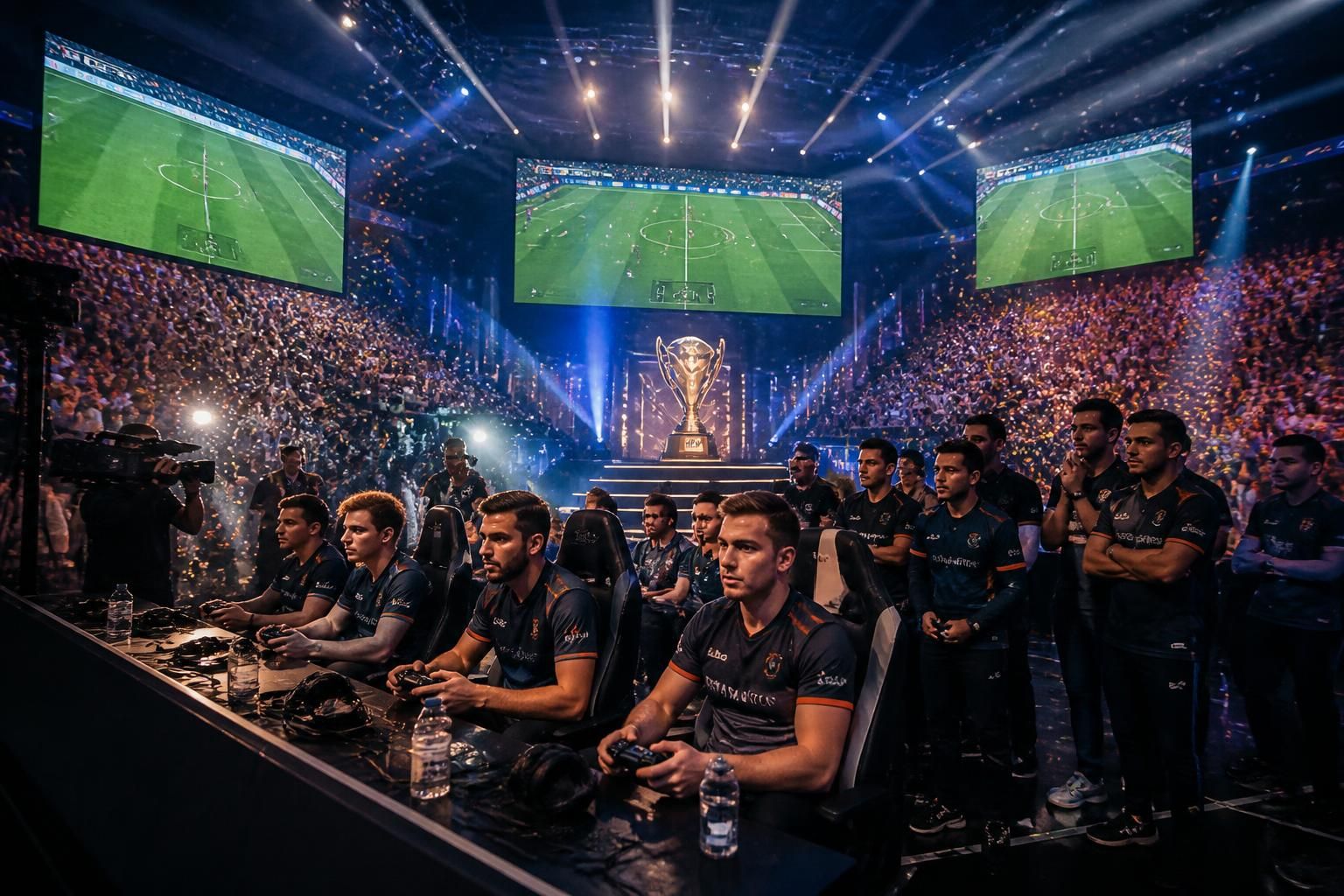
The EA Sports FC 26 E-sports World Cup has just reached a decisive milestone with the end of the Play-Ins, those high-pressure matches that allocate the last spots in the main bracket. In this format, having a solid game plan is not enough: you also need to execute it without shaking during short sequences, often dictated by the current meta and the national team choices available in the dedicated mode.
The context is all the more particular in that the World Cup mode of FC 26 relies on a very structured licensing base, and on an update with massive content on gameplay and economy. Between balancing adjustments, the arrival of a Token Store, and very visible bonuses like a free Pelé card, the preparation of professional esports players was done on a game version where every detail can change a match. The Play-Ins thus served as a reveal: the finalists come out of a path that looks less like a formality and more like a full-scale crash test of the actual competition level.
EA Sports FC 26 E-sports World Cup: what the Play-Ins really decided
The Play-Ins do not only reward creativity: they favor players capable of chaining games without losing their bearings. In this type of tournament, risk management becomes a marker: some seek the quick goal, others shut down the midfield to let time flip the match.
The most telling point remains the gap between “ladder” profiles and those used to professional esports. The former can shine in a match, but the Play-Ins demand a routine: restart patterns, managing downtime, and reading the opponent’s pressing over several games. This filter mechanically reduced the field of contenders and shaped the list of finalists.
In FC 26, the World Cup mode relies on a structuring data point: 53 officially licensed national teams, including 41 already qualified for the competition, as highlighted by an article from GEEKNPLAY dedicated to the 2026 World Cup update (date not specified in the provided excerpt). This catalog is not neutral: it imposes choices on “safe” nations and more atypical selections, sometimes less balanced but capable of surprising depending on the meta.
Finalists: why the meta weighed on team choices and game plans
The current meta often pushes to secure the central axis and protect transitions, especially when the penalty is immediate. Finalists coming from the Play-Ins are generally those who limited chaotic scenarios: turnovers in zone 2, forced restarts, and avoidable fouls at the edge of the box.
One element has also circulated in competitive discussions: the nerf of the Bruiser playstyle, mentioned in the Red Bull article about the availability of the World Cup update on EA FC 26 (date not specified in the provided excerpt). Such an adjustment changes duels and the ability to “break” an action without conceding dangerous situations, which forces some players to defend more cleanly and better manage cards.
EA Sports FC 26 and the Esports World Cup: a denser 2026 format, harder to read
The E-sports World Cup format evolves: a league phase is mentioned, with an increased number of participants. The most concrete information concerns the allocation of spots: Saudi Arabia obtains two additional places, and the Play-Ins become more attractive, as indicated by a titled article on the format revamp (source and date not specified in the provided excerpt).
On the ground, this has an immediate effect: more meaningful matches, more style clashes, and less space to “build up”. Players capable of adapting quickly come out as winners. The league phase, when well calibrated, also limits runs too dependent on the draw, but highlights regularity and mental endurance.
Table: concrete references on the World Cup mode and FC 26 competitive ecosystem
The following elements synthesize what really changes for the competition, based on publicly cited information from the excerpts (GEEKNPLAY, Red Bull, Numerama, EA Sports patch notes pages mentioned, dates not specified in the provided excerpt).
| Measurable element | Value / reference | Direct impact in competition |
|---|---|---|
| Officially licensed national teams | 53 | More nation choices, but balancing to watch according to the meta |
| Already qualified nations (mentioned) | 41 | Clear framework for preparation and World Cup-oriented scrims |
| Additional spots for Saudi Arabia | 2 | Expanded access, increased density at qualifiers and Play-Ins |
| Balancing adjustment cited | Nerf of the Bruiser playstyle | Less permissive duels and interceptions, more technical defense |
| Dedicated economy / progression | Token Store | Resource management and squad optimization to integrate into planning |
Video game, patch and economy: what the update changes for professional esports
In an esports competition, balancing matters as much as training. When an update modifies a playstyle, the value of certain defenders, the way to aggress the ball carrier, or tolerance on contacts, the game plan must be adjusted quickly.
The Token Store, mentioned in the Red Bull article on the World Cup update, introduces an optimization logic beyond the pitch. In practice, this pushes organizations to formalize a routine: playtime, resource recovery, composition tests, then validating a stable setup before high-stakes matches. The Play-Ins showed that those arriving with a well-rehearsed “plan A” avoid last-minute patch-ups.
List: observable signals of a solid finalist after the Play-Ins
- Ability to score without exposing oneself: placed attacks, few turnovers through the center.
- Restart variants: alternation between short play and diagonals to break pressing.
- Tempo management: slowing down after a goal, avoiding rush in heated minutes.
- Mastery of duels after the patch: defending standing, limiting “automatic” tackles.
- Set-piece plans: repeated routines, identified target players.
- Adaptation during the match: changing pressing and animation without losing balance.
At this stage of the tournament, these clues do not guarantee a title, but they explain why some profiles systematically stand out when the pressure rises.
What do we say about it?
Qualification through Play-Ins mainly validated a hierarchy: finalists are those who master “dirty” games, when the video game does not run smoothly and the slightest transition can be costly. The denser format, with a league phase and more participants, will logically favor players capable of being consistent rather than spectacular on a given night. Changes linked to the World Cup update (balancing, Token Store) strengthen the advantage of organizations working like professional esports, with preparation and routine. For the rest of the tournament, the most probable scenario is dominance of the most tactically disciplined profiles, because the meta and pressure punish free-risk taking.
What are the Play-Ins in the EA Sports FC 26 E-sports World Cup?
The Play-Ins are a high-stakes qualifying phase that distributes the last tickets for the rest of the tournament. The format is designed to filter quickly: it rewards consistency, pressure management, and adaptation to the meta. In EA Sports FC 26, this often plays out on details of restarts, transitions, and defensive discipline.
How many national teams are available in the FC 26 World Cup mode?
The FC 26 World Cup update features 53 officially licensed national teams, including 41 already qualified nations, according to information relayed by GEEKNPLAY in its article on the 2026 World Cup update (date not specified in the provided excerpt). This framework influences preparation and team selection choices in competition.
Why can a nerf like the Bruiser playstyle change the level of a tournament?
A balancing adjustment directly impacts duels, the ability to recover quickly, and contact tolerance. When a playstyle is weakened, some automatisms become less effective and expose more to fouls or counters. Red Bull mentions a nerf of the Bruiser in its presentation of the update, which forces more proper defending.
What is the purpose of the Token Store in the World Cup update on EA Sports FC 26?
The Token Store introduces a layer of resource management and optimization around the World Cup mode. In an esports setting, this can structure preparation: planning playtime, securing useful upgrades, stabilizing a squad, and avoiding late configuration changes. It is a parameter that can impact consistency.