
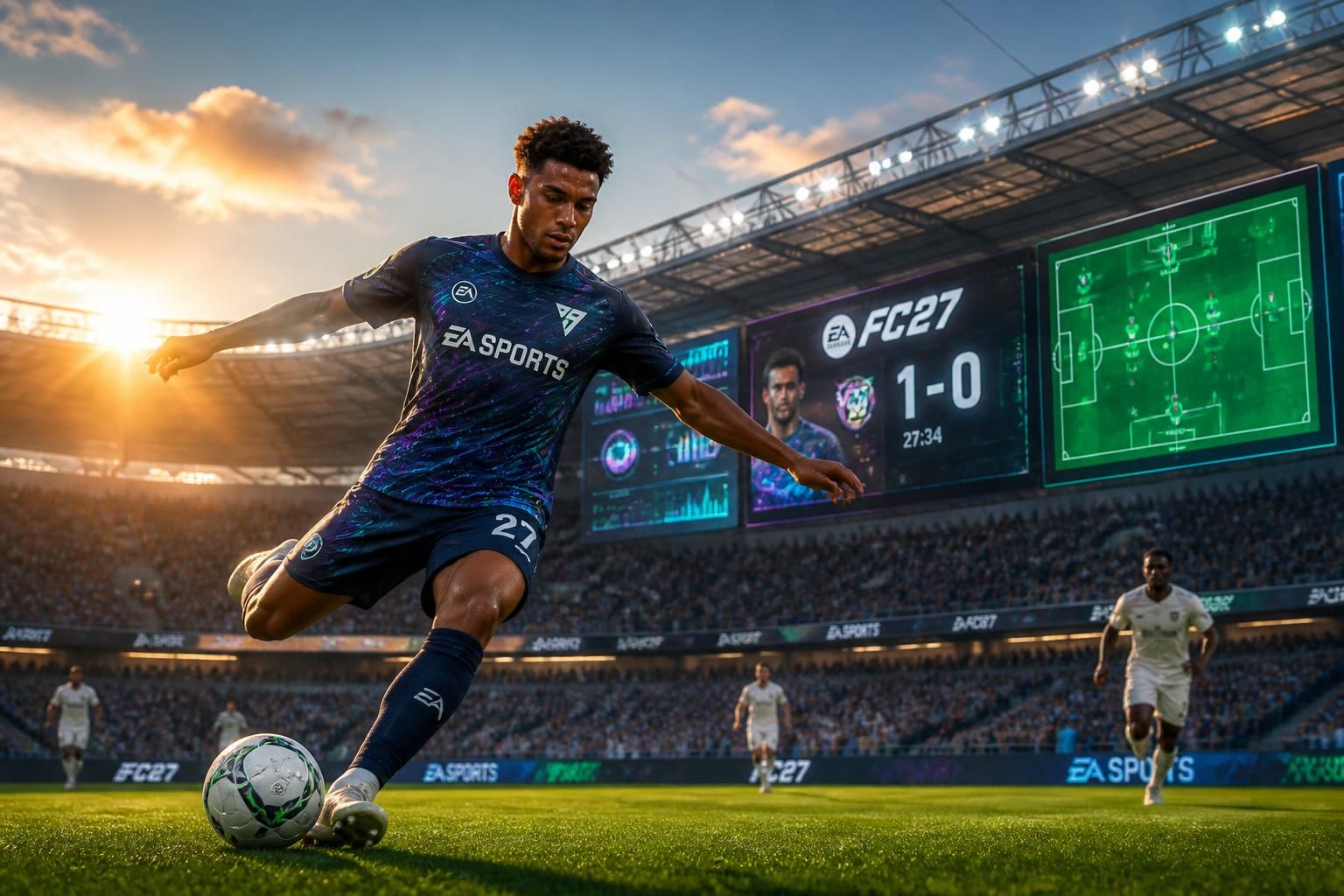
In Brief
- EA Sports FC 27 puts the Career mode at the heart of its new features, with a announced overhaul of the transfer market and management tools.
- Player progression relies on a dynamic overall rating, designed to better reflect form, confidence, and playing time throughout the season.
- Scenarios created by the community are meant to refresh replayability by adding varied starting contexts for coaches and players.
- The player experience aims for enhanced immersion through more events, choices, and consequences, beyond just a sequence of matches.
- The goal is clear: to make Career mode a true football and strategy simulation, closer to a club’s daily reality.
EA Sports FC 27 intends to mark a clear milestone for Career mode, long driven by incremental evolution rather than visible breakthroughs. The publisher highlights an in-depth revision of the solo experience, with the ambition to bring team management, player progression, and market reading closer to what fans expect from a modern simulation. On paper, the promise is of a more alive Career, where each season is no longer reduced to a calendar grid and a few negotiations, but to a series of decisions that impact a club’s trajectory.
The announced change primarily concerns the structure: transfers, development, context, and systemic narrative. EA Sports FC 27 targets both the coach Career and the player Career, with additions designed to diversify paths and encourage less repetitive strategic approaches. In a football video game where Ultimate Team often monopolizes attention, the message sent is strong. The result will depend on execution, but the stated direction finally positions Career mode as a cornerstone, not an ancillary menu.
EA Sports FC 27 and the overhaul of Career mode: what changes in the simulation
The heart of the claimed revolution lies in management loops: recruiting, developing, arbitrating, and living with consequences. EA highlights a revamp of the transfer market, presented as more structured, with more stages and competition on deals. Within the logic of a simulation, this can change how to build a team: a development club does not play the same moves as a title contender, and recruitment windows should no longer be treated as a mere list of names.
Another focus: progression. A dynamic overall rating is announced to better reflect a player’s status over time, with a reading less fixed than theoretical potential. The idea is known to sports management enthusiasts: the evaluation is not just an average, it depends on context, form, and usage. If the system is well balanced, the player experience can gain credibility, making some decisions riskier and others more rewarding mid-term.
Reimagined transfer market: a less automatic strategy
In a classic Career mode, the market often ends up boiled down to optimizations: spotting a sure value, negotiating quickly, stacking young players with high potential. The announced overhaul aims to break this routine by adding parameters that force you to choose, wait, and sometimes give up. A rival club stepping in, a negotiation dragging on, a player shifting priorities — these are details that can tilt a season.
Concrete example: a mid-table team targeting a promising striker might have to decide between overpaying to secure the deal, or waiting and risking seeing him sign elsewhere. In a football simulation, tension often comes from this type of dilemma more than from a simple stats increase.
Dynamic overall rating: progression, form, and playing time front and center
A credibly fluctuating rating can transform weekly management. Should a performant but underused player be started despite the risk of destabilizing the team, or managed as a rotation option? Conversely, a prestigious recruit struggling can drag down the team if the system truly reflects loss of confidence and lack of automatism.
This type of mechanic can also restore value to “ordinary” matches: a tough away game, three matches in seven days, a return from injury. If curves are well calibrated, evolution becomes visible without the video game falling into arbitrariness.
EA Sports FC 27 novelties for immersion: community scenarios and livelier seasons
EA highlights the arrival of scenarios created by the community, aimed at varying starting points and breaking repetition. In Career mode, replayability often hinges on the early hours: objectives, financial context, shaky squad, board expectations. More numerous scenarios can offer more targeted challenges than a simple “lead X club to the title.”
A more immersive Career also comes from a greater presence of events and choices, with readable consequences. Strategy fans expect clear systems: a decision must be understandable, its effects visible, and the whole coherent over a full season. If these novelties are integrated without drowning the player in pop-ups, the player experience can gain density.
Examples of scenarios that can renew a career
The value of scenarios will depend on the level of constraint and variety. A good basis is to offer situations that impose a playing identity or specific management, while leaving enough freedom to build. Here are formats that speak to football and simulation fans:
- Rebuilding after relegation with an obligation to reduce the wage bill and promote youth.
- Club qualified for European Cup with a short squad and the need to manage rotation across two competitions.
- Ban on recruiting outside a country or region, forcing a coherent scouting strategy.
- Imposed objective to sell a key starter before the end of the transfer window and compensate with a different profile.
- Start with a fragile dressing room where managing playing time and statuses becomes a priority.
These frameworks have an advantage: they create stories without imposing heavy written narration. The season becomes a sequence of arbitrations, which fits the DNA of Career mode.
EA Sports FC 27 Career Mode: better distinction between coach and player careers
EA Sports FC 27 promises a clearer approach between the coach career and the player career. On the bench, expectations focus on overall management: recruitment, financial balance, rotation, group dynamics. On the field, the pleasure comes from the role, position, development, and individual objectives. When these two experiences resemble each other too much, Career loses some of its flavor.
The announced overhaul emphasizes new ways to approach these two paths. For the user, the challenge is to quickly feel that decisions are not the same. A coach can transform a club through strategy, while a player must exist within a collective, accept a status, force a starting spot, or restart elsewhere.
What players expect from a true solo career in 2026
Career mode has a loyal audience seeking something other than online competition. Expectations are identifiable and measurable in the feeling: quick menus, useful information, impactful decisions, coherent progression. The announced novelties go in this direction if they serve the pace rather than weigh it down.
A frequently decisive point concerns clarity: knowing why a player progresses, why a transfer fails, why a dressing room becomes tense. Without clear explanations, the simulation becomes frustrating even when it is deep.
Comparison table: impact of main novelties on simulation and strategy
The announcements revolve around four pillars: transfers, progression, replayability, and immersion. The table below summarizes what each block concretely changes in a career, focusing on observable in-game effects.
| Novelty | Career mode area | Concrete effect on strategy | Risk if poorly balanced |
|---|---|---|---|
| Reimagined transfer market | Recruitment | More competition and arbitrations on timing and price | Negotiations too long or too harsh |
| Dynamic overall rating | Development | Finer management of form, morale, and playing time | Variations perceived as random |
| Community scenarios | Replayability | More varied career starts and better framed challenges | Scenarios too similar or poorly refreshed |
| Enhanced immersion (events/choices) | Season management | More visible consequences on squad and club dynamics | Overlay of alerts breaking the rhythm |
Privacy and customization: what cookie banners remind us in the video game ecosystem
The digital environment around a football video game goes beyond the product itself: online services, usage statistics, customization, and audience measurement structure the ecosystem. Consent banners, now standard on many web services, recall the general logic: distinguishing what serves to deliver the service, from what aims at measurement, abuse protection, or content and advertising personalization.
In practice, these mechanics weigh on the player experience outside matches: recommendations, highlighted content, and sometimes targeted advertising depending on settings. For the audience, the important point remains control: accept all uses, refuse additional uses, or refine via privacy options. In a universe where modes and events renew quickly, understanding these choices avoids unpleasant surprises.
What do we think?
EA Sports FC 27 gives Career mode a visible priority, and the combination of revamped transfers + dynamic overall rating can truly change how to build a season. The addition of community scenarios is the best idea to break routine, provided selection and variety keep up over time. The most sensitive point will be balancing: if the systems produce understandable effects, simulation and strategy will gain credibility. For solo players, this direction is the most relevant to strengthen the player experience without relying on a competitive mode.
Does EA Sports FC 27 Career mode also concern the player career?
Yes, the announcements mention changes designed for both the coach career and the player career. The stated goal is to offer new ways to approach both paths, with enhanced immersion and more reactive progression systems. The interest, if well executed, is to prevent the two experiences from becoming too similar in practice.
What is the purpose of the dynamic overall rating in EA Sports FC 27?
The dynamic overall rating aims to make a player’s evaluation less fixed. It is supposed to better reflect factors like form, confidence, and playing time over the season. For strategy, this can give more weight to rotation, injury returns, and periods of poor form, with visible effects on performance.
Do community scenarios really change the replayability of Career mode?
They can change it if these scenarios offer clear constraints and varied contexts from the start. A good scenario forces recruitment, training or objective choices, renewing a career without imposing heavy narration. Their value will mainly depend on the diversity of situations and their renewal over time.
Is EA Sports FC 27 more a simulation than a simple arcade football game?
The novelties highlighted for Career mode clearly go in the direction of simulation, with more management parameters and expected consequences over a season. This does not mean the whole game abandons an accessible approach, but the solo part aims for a more structured experience. The balance of systems will decide the final feeling.