
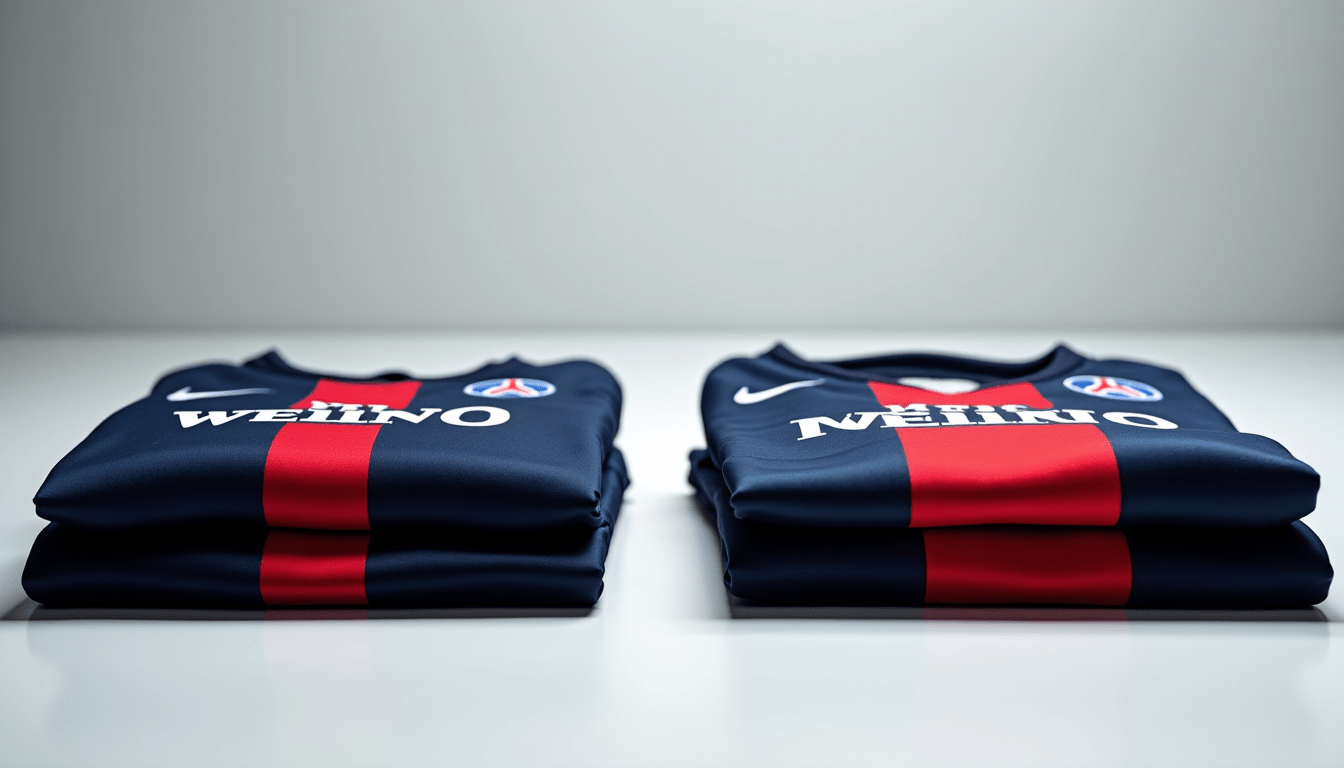
The global sports goods market is worth billions of euros, and football shirts, symbols of belonging and passion, make up a significant portion of it. Among them, Paris Saint-Germain jerseys enjoy immense popularity, attracting fans from all corners of the globe. However, this popularity has a downside: the ubiquity of counterfeits. These imitations, often sold at attractive prices, can deceive an untrained eye, disappointing supporters and damaging the club’s image. That is why knowing how to distinguish an official jersey from a reproduction is a valuable skill for any buyer wishing to support their team with an authentic product.
Recognizing a genuine official PSG jersey from counterfeit ones is not mere curiosity, but an essential step to guarantee the quality of your purchase, support the football economy and avoid disappointment. The differences often lie in the details, invisible at first glance but revealing of authenticity or falsification. We offer a detailed guide to sharpen your eye and enable you to confidently acquire the jersey of your favorite team.
From the texture of the fabric to the precision of the logos, through security labels and points of sale, every element provides a crucial clue. By familiarizing yourself with these characteristics, you will be able to make an informed choice and wear proudly an item that respects the spirit of the club. Let’s dive together into the intricacies of authenticating Parisian jerseys.
Why knowing how to distinguish an official jersey from counterfeit PSG jerseys is essential?
Buying a jersey of your favorite club goes far beyond purchasing a simple piece of clothing. It is an act of commitment, a way to show support and connect with a community of enthusiasts. Unfortunately, the market is flooded with counterfeits, making the task of finding an authentic item sometimes complex. It is therefore fundamental to know how to recognize an official jersey, not only for your own satisfaction but also for ethical and economic reasons. It is a process that ensures the quality and durability of your investment, while respecting the work of creators and manufacturers.
The first reason lies in the intrinsic quality of the product. An official jersey is designed with cutting-edge materials, the result of ongoing research and development. These technical fabrics, such as those integrating moisture-wicking technologies, offer optimal comfort, breathability and durability that counterfeits cannot match. The seams are robust, the logos are applied precisely and withstand repeated washing. In contrast, a counterfeit jersey often uses cheap materials, poor-quality dyes and sloppy finishes, resulting in less comfort, rapid wear and premature fading.
Moreover, buying an authentic jersey directly supports the club and the industries that work with it. A portion of the revenue generated from the sale of official products is reinvested in the development of the team, youth training, improvement of infrastructure or event organization. By choosing an official jersey, you actively contribute to the life and prosperity of Paris Saint-Germain. Counterfeits, for their part, feed illegal networks, often linked to precarious working conditions and lack of respect for environmental and social standards. Your decision to buy authentic therefore has a positive impact on the entire value chain.
Finally, a supporter’s pride is inseparable from the authenticity of their equipment. Wearing an official jersey is a way to show respect for the club’s history, colors and values. It is also the guarantee of owning a collectible piece that will retain its value over time. Faced with the growing popularity of PSG jerseys – PSG jerseys 2026 2027, knowing how to recognize them becomes a necessity for any fan who wishes to express their support in the most accurate and highest-quality way possible.
Indicators of authenticity: the label and serial numbers
One of the first steps to verify a jersey’s authenticity lies in the careful examination of its labels and serial numbers. These elements, often neglected, are true identity cards for the garment and contain crucial information that counterfeiters find difficult to reproduce faithfully. An official jersey is always accompanied by a specific set of labels, internal as well as external, each bearing specific details.
Inner labels: a wealth of information
Inside the jersey, usually at the collar or on the side seam, you will find several labels. The main label indicates size, fabric composition and washing instructions. On an authentic jersey, this information is printed with great sharpness, without smudging or spelling mistakes. The text is clear, the washing symbols are precise and the typeface is uniform. Counterfeits, on the other hand, may present blurred text, poorly drawn symbols or linguistic errors.
Just below the size label, jerseys from major sports equipment manufacturers often include a small additional label, sometimes holographic, with a unique serial number. This number is specific to each jersey and can sometimes be verified on the manufacturer’s website. Counterfeiters try to imitate them, but the quality of the hologram is often poor, the numbers can be repeated on several jerseys or the number may not match a valid format.
The external label: the seal of authenticity
On new jerseys, a cardboard tag is generally attached to the garment. This tag contains the manufacturer’s logo, the club’s, the price, the product reference and sometimes a barcode. Again, print quality is paramount. Logos are sharp, colors faithful and information readable. The barcode, if scanned, should lead to the exact product reference. Counterfeits may have lower-quality tags, with pixelated images or inconsistent information.
Additionally, many official jerseys include an authentication technology using a QR code or NFC. This is a small label (sometimes sewn, sometimes a heat-applied dot) that you can scan with your smartphone. This scan redirects you to an official web page of the manufacturer or the club, confirming the product’s authenticity. If the scan does not work, or redirects you to a suspicious site, there is a strong chance the jersey is counterfeit. Pay close attention to these details, as they represent an essential line of defense against imitations.
Material quality and finishes: a guarantee of reliability
The feel to the touch and the visual inspection of materials and finishes are revealing tests of a jersey’s authenticity. An official jersey is the result of advanced textile engineering and a rigorous manufacturing process, aspects that counterfeiters struggle to reproduce without significant compromises. The difference is often noticeable from the first contact and confirmed by close inspection.
The fabric: a specific texture and technology
Official Paris Saint-Germain jerseys, notably those designed by world-renowned manufacturers, use patented fabric technologies. For example, Dri-FIT technology allows moisture to be wicked away to keep the player dry, while Vaporknit technology offers optimal lightness and elasticity. These fabrics have a particular texture: they are generally soft to the touch, lightweight, and present some elasticity without deforming. They also feature a mesh-like structure, visible when held to the light, designed for breathability.
A counterfeit jersey will often use low-grade polyester. To the touch, it may feel rougher, heavier or less flexible. The visual appearance may reveal excessive shine or, conversely, an artificial matte finish. The fabric’s ability to wick moisture will be nearly nonexistent, making the jersey uncomfortable to wear, especially during physical exertion. Observe the fabric weave carefully: on an official jersey it is regular and homogeneous, whereas on a counterfeit it can be irregular, with pulled threads or thinner areas.
The seams: precision and robustness
The seams of an authentic jersey are an example of precision and durability. They are regular, straight, without loose threads or unnecessary double stitching. The stitches are tight, ensuring the solidity of the assembly. Critical areas, such as the shoulders or armpits, may feature reinforced seams or flat-seam techniques to avoid chafing. The thread used is high quality and generally matches the jersey’s dominant color or is an intentionally contrasting color.
On a counterfeit, the seams are often the first sign of negligence. They can be crooked, irregular, with large gaps between stitches. It is common to find protruding threads, poorly finished stitches or seams that come undone after a few washes. Junction areas between different panels of the jersey, which require great dexterity, are often poorly executed on imitations, creating pleats or abnormal tensions in the fabric.
The finishes: attention to detail
Beyond the seams, all the finishes testify to authenticity. The hems of the sleeves and bottom of the jersey are perfectly straight and regular. The neckline is well shaped, without distortion. If the jersey has side stripes or panels of a different color, the junction is neat and precise. The prints (numbers, names, sponsors) are applied with high-quality heat-pressing techniques, making them smooth to the touch, without air bubbles or edges that peel. They are durable and withstand washing.
On counterfeits, the prints can be crude, with a sticky or uneven texture. The edges may be poorly cut or start to lift from the first use. The color of the prints may not exactly match that of official jerseys. Even the smallest details, such as the shape of laser-cut ventilation holes on the “Authentic” versions of jerseys, are reproduced with unmatched precision on official products, while they are often simplified or absent on imitations.
Logos and crests: pay attention to details
Logos and crests are the most visible symbols on a football jersey, and their reproduction is an art that official manufacturers master perfectly. That is why a careful examination of these elements can glaringly reveal the nature of a counterfeit. Every detail counts: the embroidery, the color, the position, and even the texture.
The Paris Saint-Germain crest
The PSG crest is a central element of the jersey. On an official jersey, the crest is generally embroidered or heat-applied with great precision. If embroidered, the threads are dense, regular, and the colors (blue, red, white) are vivid and faithful to the club’s graphic guidelines. The stars and the Eiffel Tower are perfectly defined, without any loose threads or overflow. The overall shape of the crest is impeccable, without deformation. If heat-applied, the crest is flat, smooth to the touch, and its contours are sharp, without any air bubbles or signs of peeling.
On a counterfeit, the crest may appear flat and without relief, even if embroidered. The embroidery may be loose, with protruding threads, dull or slightly off colors. The shape of the Eiffel Tower or the stars may be simplified, deformed or poorly proportioned. Heat-applied crests on counterfeits are often poor quality, with edges that lift, a grainy texture, or a cheap “plastic” look. The position of the crest in relation to the center of the chest or the manufacturer’s logo is always exact on an official jersey, whereas it can be slightly off on an imitation.
The manufacturer logo
The manufacturer’s logo (for example, the Swoosh) is another essential indicator. On an official jersey, this logo is either embroidered with the same quality as the club crest, or heat-applied with impeccable finishing. The shape is perfect, proportions respected, and the color is faithful. If embroidered, the stitches are tight and regular. If heat-applied, it is smooth and integrated into the fabric without roughness.
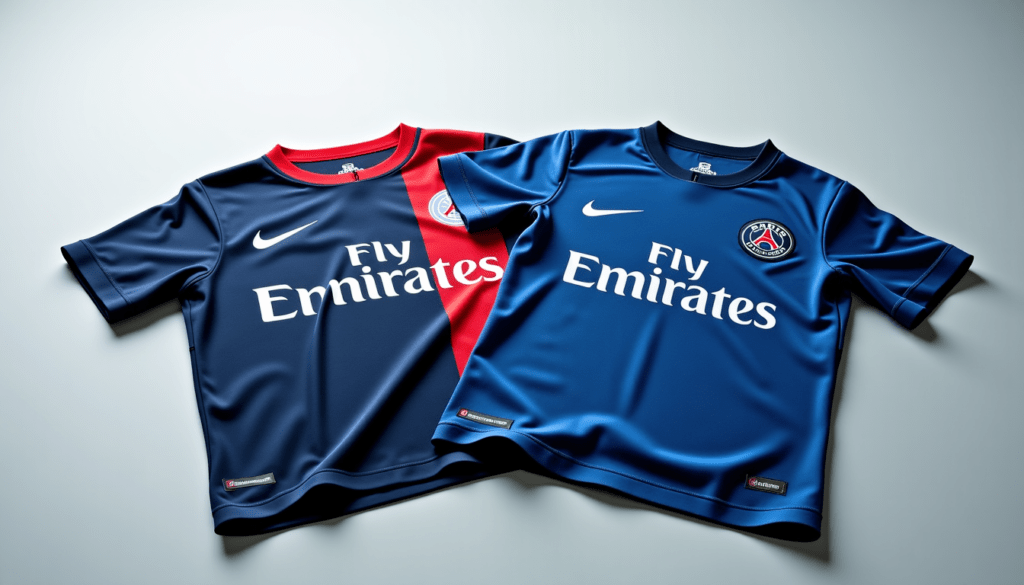
Counterfeits often feature poorly executed manufacturer logos. The Swoosh can be slightly deformed, too thick or too thin, with irregular edges. The embroidery may be of poor quality, with threads coming loose, or the heat-applied application may have air bubbles or a shiny, cheap appearance. It also happens that the logo is printed directly on the fabric rather than embroidered or heat-applied, which is a sure sign of counterfeit for most high-end football jerseys.
Sponsor logos and prints
Main sponsor logos (front, sleeves, back) are also points to check. On an official jersey, these logos are applied with great precision, either by high-quality heat-pressing or by screen printing. Colors are exact, typefaces respected, and size and position conform to the club’s and sponsors’ specifications. Player name and number prints are also impeccable: the material is soft to the touch, the edges are sharp and the adherence is perfect.
On counterfeits, sponsor logos can have slightly different colors, incorrect fonts or disproportionate sizes. They may be misaligned, have irregular edges, or show signs of rapid peeling. Player name and number prints are often of inferior quality, with a rough texture, bubbles, edges that lift easily, or colors that fade after a few washes. The very material of the print can differ from the original, being thicker, stiffer or shinier.
Here is a summary table of key differences to observe on logos and crests:
| Élément | Maillot Officiel | Maillot Contrefait |
|---|---|---|
| Écusson PSG | Broderie dense/thermocollage lisse, couleurs vives, détails précis (Tour Eiffel, étoiles), positionnement exact. | Broderie lâche/thermocollage texturé, couleurs ternes/fausses, détails simplifiés/déformés, positionnement approximatif. |
| Logo équipementier | Broderie parfaite/thermocollage impeccable, forme et proportions exactes, couleur fidèle. | Broderie imparfaite/aspect brillant, forme déformée, couleur altérée, parfois juste imprimé. |
| Sponsors | Thermocollage/sérigraphie de haute qualité, couleurs exactes, polices respectées, taille et positionnement précis. | Qualité d’application variable, couleurs/polices incorrectes, taille/positionnement approximatifs, tendance au décollement. |
| Flocages (noms/numéros) | Matière douce et intégrée, contours nets, tenue parfaite, couleur durable. | Matière rugueuse/épaisse, bulles, bords qui se soulèvent, couleur qui s’estompe. |
Price and point of sale: warning signs not to be overlooked
Beyond the purely visual and tactile aspects of the jersey, the context of the purchase itself provides valuable clues about the product’s authenticity. The displayed price and the place where you make your transaction are often major warning signs that should never be ignored.
Price: beware of offers that are too good to be true
An official football jersey, whether the “stadium” version (replica for fans) or the “authentic” version (identical to what players wear), represents manufacturing costs, research and development, as well as licensing fees. These elements are reflected in the retail price. A new official jersey, whether from the current collection or a previous one, has a floor price below which it is difficult to go while remaining profitable for an authorized reseller. If you find a new jersey at a derisory price, for example €30 or €40 for a model that usually costs €80 to €150, there is a strong chance it is a counterfeit. Promotions do exist, of course, but they are rarely so drastic on popular, recent items.
It is always wise to check the usual prices for the model you desire. A small price difference can be due to a legitimate promotion or a reseller clearing stock. However, a gap of more than 50% compared to the reference price should immediately make you suspect an imitation. The cost of an authentic item reflects the quality of the materials, the integrated technology and adherence to ethical production standards. A price that is too low is often a symptom of low-cost production with no regard for these standards.
Point of sale: favor official channels
The place of purchase is probably the most reliable indicator of authenticity. To be certain of acquiring an official jersey, the safest option is to turn to authorized distribution channels. This includes the club’s official store (physical or online), the sports equipment manufacturer’s shops (for example, Nike stores), or major reputable sports retailers that have partnerships with these brands. These resellers are directly supplied by manufacturers and guarantee the authenticity of their products. They also offer return guarantees and reliable customer service.
Conversely, be extremely cautious on generic online marketplaces, flea markets, street vendors or websites with suspicious-looking URLs. These channels are fertile ground for the proliferation of counterfeits. Even on peer-to-peer selling platforms, caution is advised. If you buy through these channels, make sure the seller has an excellent reputation, provides detailed photos of the product from all angles (including labels and logos), and is willing to answer all your questions. An honest seller will have nothing to hide.
“The authenticity of a jersey is not only a question of brand, it is a question of respect for the sport, the players and the fans who share a common passion. Choosing official is honoring that passion.”
Some counterfeit websites are very sophisticated and can mimic the appearance of official sites. Always check the URL: it should be that of the club, the manufacturer or a major recognized distributor. Beware of strange domain names, spelling mistakes in the site address or prices displayed in unusual currencies. Secure payment (HTTPS) is a minimum, but it does not by itself guarantee the authenticity of the product sold. Vigilance is required at every step of the purchasing process.
A buying guide for an authentic PSG jersey
To help you navigate the market and make a confident purchase, here is a practical guide in the form of a checklist of key points to verify before finalizing the acquisition of your Paris Saint-Germain jersey. By following these steps, you will maximize your chances of owning an official, high-quality item.
- Choose an official retailer: Always favor the PSG official store, the manufacturer’s website (Nike, for example) or well-known sports retailers. These channels guarantee authenticity.
- Examine the price: Beware of offers that are too good to be true. An official jersey has a reference price. Large discounts not justified by a sale period or massive clearance are suspicious.
- Check the inner labels: Look for size, composition and washing labels. Make sure the text is sharp, without spelling mistakes, and that the symbols are clear. Search for a unique serial number or a security hologram.
- Inspect the external tag: The cardboard tag must be high quality, with sharp logos and product reference information. The barcode must match the jersey reference.
- Feel the fabric: An official jersey uses specific technical fabrics (Dri-FIT, Vaporknit). It should be soft, light, breathable and slightly elastic. Counterfeits are often rougher or heavier.
- Examine the seams: Seams should be straight, regular, tight and without loose threads. Finishes should be flawless across the jersey.
- Check the club crest: Whether embroidered or heat-applied, the crest must be of impeccable precision, with faithful colors, fine details and exact positioning.
- Verify the manufacturer logo: The Swoosh must be perfectly formed, well embroidered or heat-applied, without any deformation or color alteration.
- Analyze sponsor logos: Sponsor prints must be clean, without bubbles, with correct colors and fonts, and firmly applied.
- Pay attention to player prints: Names and numbers must be high quality, with sharp edges, a pleasant material feel and good adhesion.
- Use authentication codes: If the jersey has a QR code or NFC, scan it to verify authenticity on the official site.
- Ask for detailed photos: If buying online from a third-party seller, request photos from all angles, including labels and specific details.
Summary: Ensuring the authenticity of your PSG jersey
Purchasing a Paris Saint-Germain jersey is an important moment for any supporter, a gesture that symbolizes attachment to their club. Faced with the proliferation of counterfeits, vigilance is required. We have explored together the multiple facets that allow distinguishing an official item from a pale imitation. This process is not limited to a quick glance but requires particular attention to a multitude of details, ranging from the product’s origin to the fineness of its finishes.
In summary, a jersey’s authenticity is revealed by the consistency of all its characteristics. An abnormally low price, a dubious point of sale, blurred or inconsistent labels, sloppy seams, imprecise logos or poor-quality prints are all warning signs not to ignore. An official jersey is the result of technical know-how and a commitment to quality—qualities that show in every fiber and every stitch.
Your role as a fan is to be an informed consumer. By choosing to buy from authorized retailers and equipping yourself with the knowledge necessary to identify counterfeits, you protect not only your investment but also the club and the integrity of the sport you love. This approach ensures that your passion for Paris Saint-Germain is expressed with a product that meets the club’s standards of excellence.
Never forget that authenticity is a matter of details and trust. By following the advice given, you will be perfectly equipped to make an informed choice and proudly wear your team’s colors with a jersey that deserves it. To discover a selection of PSG jerseys – PSG jerseys 2026 2027 authentic items, you can consult specialized platforms that pride themselves on offering only official products.
Frequently Asked Questions (FAQ)
Can a jersey bought on promotion be a counterfeit?
No, not necessarily. Official resellers regularly offer promotions, notably at the end of the season or during specific commercial events. However, if the promotion is excessive (for example, a jersey at 80% off for no apparent reason), this should arouse your suspicions. It is always recommended to check other indicators of authenticity, even for an item on sale.
Can I verify a serial number online?
Yes, some sports equipment manufacturers offer online verification tools. Look for a small label with a unique serial number or a QR code inside the jersey. Scan the code or enter the number on the brand’s official site to confirm authenticity. If no information is found or if the link is suspicious, be cautious.
Are “fan” jerseys of lower quality than “player” jerseys?
“Fan” jerseys (often called “stadium version”) are designed for supporters’ everyday comfort, with looser cuts and slightly different materials. “Player” jerseys (or “authentic version”) are those worn by professionals, with cutting-edge technologies for performance (lightness, increased breathability, slim fit). Although different, both are official and high-quality products. Counterfeits, however, do not reach any of these standards.
What should I do if I suspect I bought a counterfeit?
If you bought a jersey and strongly suspect it is counterfeit, contact the seller immediately to try to obtain a refund. If you purchased via an online platform, use their claims procedures. You can also report the incident to the competent authorities or consumer protection services. Keep all proof of purchase and photos of the jersey.