
In Brief
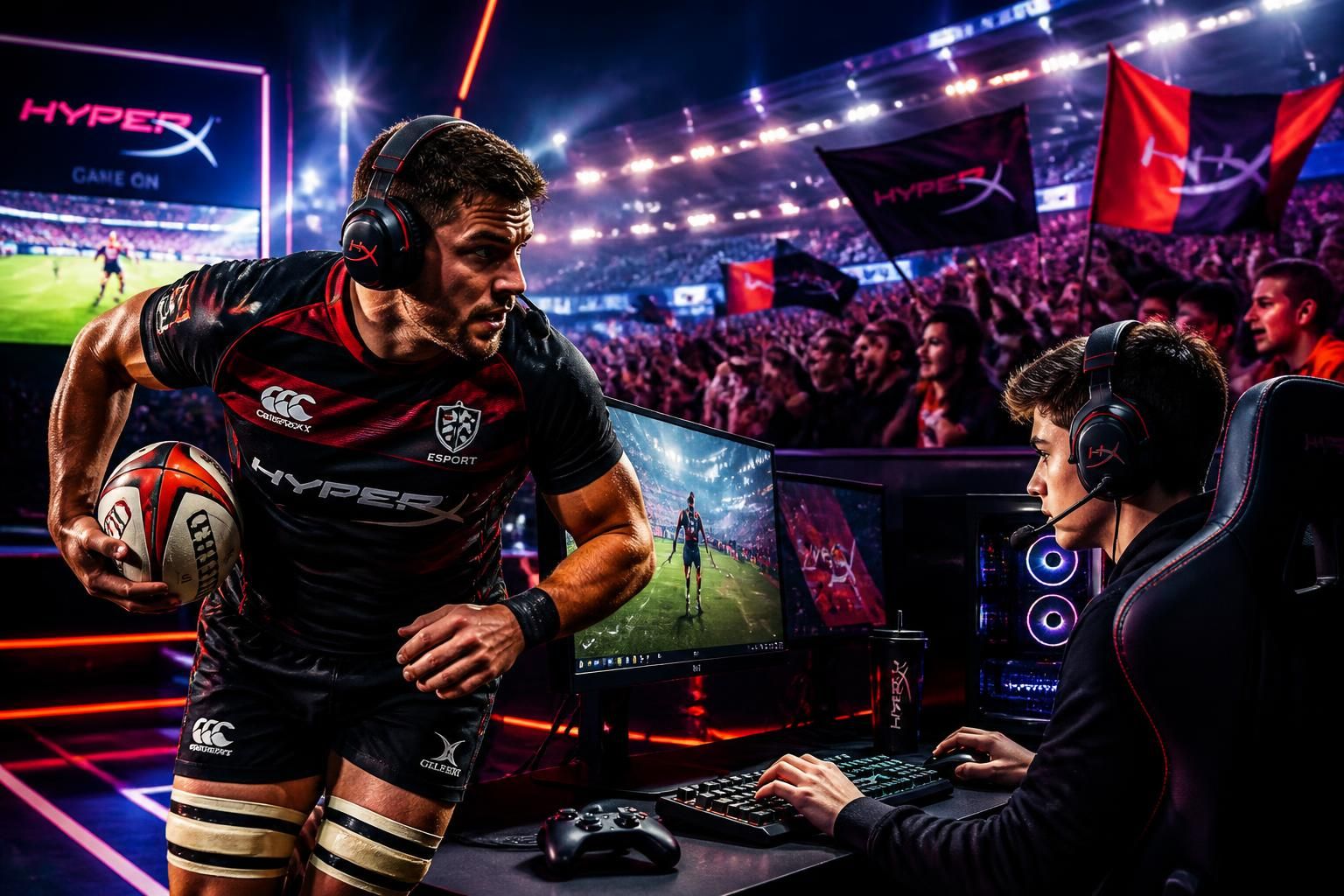
- Rugby increasingly relies on Esport and gaming to strengthen youth engagement, with hybrid competition formats and activations on mainstream games.
- Clubs are structuring dedicated sections, like FC Grenoble Rugby which officially announced the creation of FCG eSports in a statement published on April 19, 2021.
- Brands are seeking the fusion between sport and technology through immersive experiences, such as “La Mêlée” on Fortnite, an operation presented by Société Générale as a gathering between rugby and esport communities.
- The stakes go beyond communication: recruiting new audiences, commercial diversification, and modernizing the image through a content-, event-, and data-oriented strategy.
- The model is built by successive trials: tournaments, influence, streaming, and bridges to the stadium, with the same constraint of sporting credibility.
On April 19, 2021, FC Grenoble Rugby officially announced the creation of FCG eSports, a sign that part of French rugby now sees Esport as a development tool, and not just a marketing curiosity. The idea is simple: where young people consume sport through highlights, streams, and interactive formats, clubs seek more natural points of contact than advertising or ticketing. Gaming offers this ground, with its codes, competitions, influencers, and communities.
This alliance fits into a broader trend of hybridization already visible in football, where institutions like Paris Saint-Germain or FC Barcelona have structured esport sections and events mixing virtual and real. In rugby, Innovation relies less on copying these models than on adapting them: creating bridges between the match and the screen, between the player and the avatar, between performance and storytelling. The challenge is to establish a sustainable, sportingly credible strategy capable of generating engagement and revenue, without distorting rugby’s identity.
When Esport becomes a diversification lever for rugby
Rugby faces a challenge of audience renewal, particularly on long formats. Esport brings short, replayable formats centered on interaction, which fits better with young people’s use of streaming platforms and social networks.
A club no longer just “communicates” about a match: it builds an editorial presence. In this logic, Esport serves as a brand extension, with a competition calendar, recurring content, and events that exist even outside the sporting season. Diversification here also targets partners, especially those from technology, who find in gaming a clearer activation ground.
What clubs are looking for: audience, sponsors, and new stories
The most frequent objectives group into three blocks. First, broaden the audience by going where communities spend time. Next, offer measurable activation formats to advertisers more familiar with gaming than corporate boxes. Finally, produce stories: player portraits, challenges, “behind the scenes” formats, and internal competitions.
In a context where content circulates faster than posters, storytelling becomes an asset. Rugby keeps its roots but gains additional entry points, designed for mobile and social consumption.
The first announcements of esport sections, such as FC Grenoble Rugby’s, also have a symbolic dimension: they formalize a strategy and provide a framework for formerly occasional initiatives. Moving to an official team requires choices: which game, which calendar, what competition level, and which partners.
Case study: FCG eSports and structuring a local strategy
The April 19, 2021 announcement on the creation of FCG eSports marks a milestone: rugby no longer waits for Esport to “pass”, it tries to organize it. This type of approach responds to a sector reality: the competition is already here, but structuring varies depending on games, publishers, and circuits.
The difficulty for a club is to avoid the gadget effect. An esport section that only lives at launch time brings neither lasting engagement nor commercial value. The strategy must therefore include appointments, content, and integration with the club: stadium presence, ticketing operations, subscriber experiences, and collaborations with gaming actors.
Organization, calendar, and credibility: the choices that matter
Credibility is built on concrete elements: competition regularity, player level, content production, and transparency on objectives. A team that plays official matches and publishes clear follow-ups creates a more stable relationship with its community.
Clubs also seek brand coherence: visuals, tone, and values. Rugby often highlights collective and discipline; Esport must translate these codes into a gaming language, without copy-pasting formats from other sports.
Brands and activation: the example of “La Mêlée” on Fortnite
Société Générale presented “La Mêlée” on Fortnite as a first immersive experience aiming to bring together fans from the esport and rugby communities. This type of activation illustrates a trend: the fusion of sport and technology is no longer limited to sponsorship; it passes through playable, shareable, and engagement-traceable experiences.
For a brand, the game offers immediate indicators: participation, time spent, interactions, generated content. For a club, the interest is to turn a campaign into an entry point to the stadium and its products: ticketing, subscriptions, shop, partner operations.
What gaming activation changes in the relationship with supporters
The supporter no longer just watches: he participates. In gaming, the event is often designed as an experience, with challenges, rewards, and a strong community dimension. This also changes the timing: an activation can live several weeks via streams and reruns.
The risk, on the other hand, is dissonance. If the playful experience does not respect rugby codes, it can be seen as opportunistic. Successful operations are those that give a role to the public, not just disguised advertising.
In this kind of setup, the most effective strategy remains the one that connects the virtual to concrete actions: contests to win tickets, content with professional players, and on-site presence during matches. Engagement thus becomes a journey, not a simple advertising impression.
Competition and hybrid formats: how rugby adapts Esport codes
Hybrid formats are a logical field for rugby: online competitions, in-person finals, showmatches with guests, or tournaments organized during match weekends. Football has already shown the effectiveness of these mixes, with clubs like Paris Saint-Germain and FC Barcelona investing in Esport and multiplying bridges between real and virtual teams.
In rugby, the question is also that of the supporting game. Rugby titles remain less established in competition than the big Esport standards, which sometimes leads to choosing bigger mainstream games to reach a wide audience, even at the cost of losing some “rugby realism.” This compromise directly influences the strategy.
Practical list: 7 formats that work to reach the youth
- Open online tournament with weekly qualification and on-site final on match days.
- Influencer showmatch vs club players, streamed with moderation and replay.
- Community challenges on a mainstream game (time-limited, ranking, ticket rewards).
- Internal leagues for subscribers and licensees, with ranking and monthly highlights.
- Co-streaming of a rugby match with “second screen” animation (quiz, predictions, mini-games).
- Esport initiation workshops in rugby schools, supervised and associated with health messages.
- Gaming fan zone at the stadium: gaming stations, short tournaments, and content captured for social networks.
The logic remains the same: offer a readable competition, regular appointments, and an explicit link with rugby. Without this link, the operation attracts but does not retain.
Table: comparing main “rugby x gaming” models
Clubs and federations do not all adopt the same approach. The table below synthesizes observable models, with measurable indicators, useful to frame a strategy.
| Model | Typical duration of an activation | Number of content formats | Physical point of contact | Main measure |
|---|---|---|---|---|
| Official esport section (dedicated team) | 6 to 10 months | 3 to 6 (matches, training, portraits, live) | Yes (final, fan zone, stadium) | Audience recurrence (live + replay) |
| Brand activation in a game (event type) | 2 to 6 weeks | 2 to 4 (teasers, live, best-of) | Sometimes (prizes, events) | Participation and time spent |
| Community “open” tournament | 4 to 12 weeks | 2 to 5 (brackets, interviews, clips) | Optional | Number of registrants and return rate |
| Stadium + gaming fan zone setup | 1 to 2 days | 1 to 3 (capsules, vox pops, recap) | Yes | On-site flow and shared content |
A club aiming at youth in the long term is advised to favor a recurring model. Short activations work better as accelerators around a peak moment.
Technology, data and framework: what the ecosystem must master
The fusion between rugby and gaming also relies on technical choices: streaming platforms, moderation, community management, and performance measurement. Clubs discover a production requirement closer to media than events, with rapid cycles and consistent quality expectations.
The trust framework is as important as distribution. Users are now accustomed to consent banners and privacy settings popularized by major online service interfaces. Standard messages around cookies and data use (audience measurement, fraud prevention, personalization) have established a reflex: explain what is collected and why, especially when the targeted audience includes minors.
From audience measurement to moderation: the “back-office” of engagement
A credible esport project anticipates active moderation, chat rules, and a team able to manage audience peaks. The competition attracts diverse communities, sometimes more accustomed to gaming codes than rugby’s, which requires clear framing.
Performance tracking should remain simple: live audience, replay views, participation, registrations, and conversion to rugby actions (tickets, subscriptions, shop). A club that measures properly can quickly adjust formats, schedules, and platforms.
What do we say about it?
The Esport–Rugby rapprochement is one of the most effective strategies to regain youth attention, because it responds to already established uses: online competition, streaming, and interactive formats. Initiatives that will have impact will be those that assume real regularity, with a team, a calendar, and content production, like the structuring announced by FC Grenoble Rugby.
Brand activations in mainstream games, like “La Mêlée” on Fortnite presented by Société Générale, can create an engagement peak but are not enough on their own to build a community. The most probable scenario is coexistence: short events to recruit, recurring setups to retain.
The most frequent weak point remains sporting credibility: without clear competition and without a concrete link to the club, Esport becomes an isolated operation, hard to make profitable and to get accepted by traditional supporters.
Which games to choose to launch an esport project linked to rugby?
Two approaches dominate: a rugby game for sporting coherence, or a mainstream game to maximize youth audience. The choice depends on the goal (retention vs recruitment), the available competition calendar, and targeted partners. A club can also combine the two, with a rugby “core” format and a broader gaming activation on a peak time.
Is an esport section profitable for a rugby club?
Direct profitability is rare at the start, as production (staff, content, competition) costs time and resources. The most measurable benefits often come from engagement (audience, community) and the ability to attract technology-oriented sponsors. The strongest models link esport and rugby revenues: ticketing, merchandising, and stadium events.
How to avoid the gadget effect with traditional supporters?
The key is to create an explicit link with the club: player presence, formats on match days, fan zone, and content that tells the sporting life. An esport section that publishes a calendar, results, and recurring appointments is better accepted. The educational effort also matters, especially on rules, platforms, and objectives.
What vigilance points on technology and data for a young audience?
An esport setup often involves registration, chat, and audience measurement. It is therefore necessary to display clear information on data collection, moderation, and privacy settings, consistent with widely spread consent standards by major online services. Moderation and abuse prevention (spam, fraud, harassment) must be planned from the start.