
In Brief
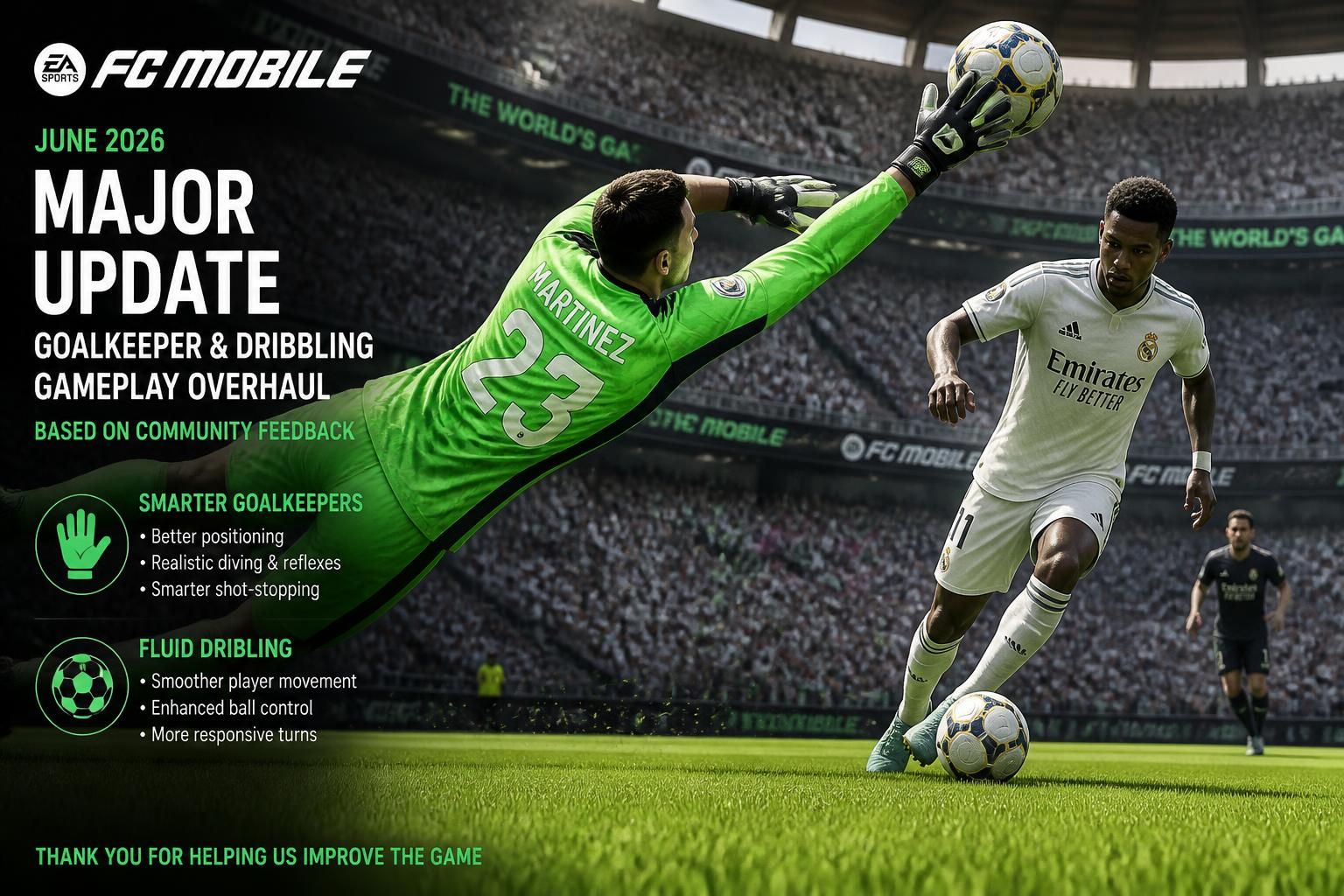
- In June 2026, FC Mobile is rolling out an update focused on goalkeeper management and dribbling, two aspects frequently criticized in matches.
- EA SPORTS presents this patch as a direct response to player feedback, featuring adjustments to animations, responsiveness, and attribute impact.
- The changes also affect the pace of actions, pass accuracy, and more consistent foul detection, with a clear goal: to stabilize performance in mobile gameplay.
- For competitive players, the immediate challenge is to reduce “weird” goals on the goalkeeper’s side and limit overly “slippery” dribbles that break the duel.
- The patch’s greatest value is mainly measured in one-on-one situations and tight spaces, where FC Mobile sometimes relied on unpredictable behavior.
EA SPORTS highlights, for the FC Mobile June 2026 update, a long-awaited focus on two areas that often decide a smartphone match: goalkeeper management and dribbling. The publisher emphasizes a community-inspired gameplay, with fixes designed to match player feedback and narrow the gap between what the on-screen action demands and what the game actually executes. The patch notes and related communications published on the official EA SPORTS FC Mobile website also mention enhanced pass accuracy, refereeing that better detects certain fouls, and attributes expected to weigh more heavily in duels.
On the field, the objective is clear: to make saves more consistent on close-range shots, avoid poorly timed goalkeeper rushes, and restore a more controlled dribbling tempo without making it sluggish. Players who continuously play Division Rivals or online matches should especially notice the difference in situations that previously triggered frustrating sequences: a goalkeeper beaten at the near post without reaction, or a dribble that bypasses a defender due to an overly permissive animation. This improvement aims for stability, a criterion as important as spectacle in a competitive mobile game.
FC Mobile June 2026 Update: What Changes in Goalkeeper Management
In its communication about the June 2026 update, EA SPORTS explicitly puts goalkeeper management at the center, with the idea of limiting actions deemed “unfair” by part of the community. In a mobile game where matches are fast-paced, a single misread ball can ruin a streak, and that’s exactly what the patch aims to fix.
The announced adjustments mainly concern one-on-one behavior, reflex saves, and some goalkeeping rushes where the timing sometimes seemed disconnected from the action. The expected outcome is a more consistent reading of low-distance shots and better coherence between the goalkeeper’s position and the result of the shot, so that performance doesn’t rely more on a “lucky shot” than the skill.
One-on-ones and Near Post: The Most Targeted Situations
Player feedback often targets the same scenes: shots at the near post that go in despite a tight angle, or duels where the goalkeeper remains frozen while the attacker is in contact. The update promises to reduce these gaps by making reactions more consistent and limiting animation “gaps.”
Concretely, this should make the ends of actions more readable: a well-constructed duel should be better rewarded, and a rushed shot should resemble more of a gamble than a guarantee. This setting changes how to attack in the box because it forces better timing and shot zone selection.
Dribbling in FC Mobile: Acceleration, Agility, and Better Duel Reading
EA SPORTS ties this update to faster dribbling and a more agile feel, with a simple promise: that the on-screen move translates more faithfully into effective movement. Part of the audience criticized dribbling for being either too “soapy” (too slippery) or too constrained depending on the sequences and perceived latency.
The publisher also mentions a stronger impact of attributes on players’ choices. The idea is that two players with different profiles shouldn’t dribble “the same way,” and that one-on-one performance better reflects a player’s profile, without turning every acceleration into an unstoppable action.
Concrete Example: Tight Spaces and Defensive Support
In tight spaces, dribbling is mostly used to create half a meter, not to cross an entire line. With this improvement, a short cut or a change of direction should better unbalance the defender, provided the timing is right and the attacker has suitable attributes.
Conversely, on defense, duels should be less affected by “phantom” collisions. This encourages a more patient defensive support, since offensive success relies more on clean sequences than on an animation that goes through no matter what.
Passing, Fouls, and Attributes: The Other Side of Gameplay Improvement
The update is not limited to goalkeepers and dribbling. EA SPORTS also indicates that passes gain accuracy and refereeing better identifies certain fouls, which directly targets match fluidity and fairness perception.
On the field, these settings can have significant impact: a more reliable pass reduces “free” turnovers, and better contact detection limits situations where a sloppy tackle turns into a favorable counter. In a competition-oriented mobile game, these details influence streaks and risk management.
What to Test After Installation to Judge Performance
To quickly gauge the update’s effect, some sequences are more revealing than others. They isolate the announced changes and avoid confusing real progress with mere impressions over a few matches.
- Near-post shots with tight angles and a placed goalkeeper: check save consistency.
- One-on-one after a through ball: observe the rush triggering and reaction speed.
- Dribbles in tight spaces (short cut then shot): verify control and animation triggering.
- Shoulder-to-shoulder duel on the wing: assess foul frequency and collision stability.
- Quick one-touch passes through the center: judge accuracy and number of “abnormal” interceptions.
If these five points show clear improvement, the update is tangible because they concentrate situations where FC Mobile often turns from a controlled match to a match endured.
Comparison Table: Before/After on Key FC Mobile Actions
The effects of an update are often judged on simple match indicators. The table below summarizes the targeted gameplay areas and what the patch aims to make more consistent, in line with EA SPORTS’ communication on this version.
| Measurable Action in Match | Observable Indicator | Expected with the Update (June 2026) | Direct Impact on Performance |
|---|---|---|---|
| Near-post shots | Save rate on tight-angle shots | More consistent goalkeeper reactions | Fewer “easy” goals conceded |
| One-on-one | Timing of rush and angle coverage | More coherent behavior at short distance | More readable duels, clearer decisions |
| Short dribbles | Trigger time and ball control | Smoother gestures, cleaner sequences | More reliable space creation |
| Quick passes | Accuracy on short touches | Fewer “off” passes on simple actions | More stable buildup |
| Contacts and fouls | Number of fouled duels vs. advantage | Better detection of certain fouls | Fewer unjustified recoveries |
Privacy and Cookies: What Changes (or Not) on Data Collection
The game update does not erase the realities of the mobile ecosystem: audience measurement, advertising, and personalization often rely on consent choices. Cookie screens, on the Google services side, generally remind users of several purposes: providing and maintaining services, tracking outages and protecting against spam, measuring engagement, then optionally personalizing content and ads.
The “Accept all” and “Reject all” options do not have the same effect: rejection limits data use for personalization, while non-personalized content and ads remain influenced by context (viewed content, general location, session activity). To adjust these settings, Google also refers to privacy management tools accessible via g.co/privacytools.
For players, the benefit is concrete: understanding what pertains to the game itself and what depends on advertising or measurement services used on the device. This clarification avoids attributing FC Mobile update behaviors to settings that actually come from consent preferences.
What Do We Say About It?
This June 2026 update goes in the expected direction because it tackles two levers that decide the immediate feeling: goalkeeper management and dribbling quality under pressure. The most likely gain will be seen in one-on-ones and close-range shots, where inconsistencies tipped close matches. The point to watch remains balance: goalkeepers that are too strong or dribbles that are too permissive would merely shift frustration to another mechanism. For most competitive players, installing the patch and re-testing the “problem” situations is clearly worth the time, as the improvement targets actions repeated dozens of times per session.
Does the FC Mobile June 2026 update really change goalkeeper management?
The patch explicitly focuses on more consistent reactions, especially on close shots and some one-on-one situations. The easiest effect to verify is consistency on near-post shots at tight angles by repeating the same actions over multiple matches. If saves become more regular, the improvement is definitely there.
Are dribbles faster or just easier?
The stated goal is a more agile gesture and smoother sequences, not automatic dribbling. In practice, the difference is measured in tight spaces: a short cut should better create half a meter if the timing is good. Attributes are also expected to weigh more, limiting the “everyone dribbles the same” effect.
Which modes feel this FC Mobile improvement the most?
Online modes, where performance and consistency matter, are the most revealing: Division Rivals, competitive matches, and any game with frequent duels in the box. Adjustments to goalkeepers and dribbling directly impact decisive situations, so the effect is noticed faster than in purely casual modes.
Why is privacy and cookies discussed in a mobile game article?
On mobile, part of personalization and measurement (content, ads, usage stats) depends on consent choices related to services used on the device. Options like “Accept all” or “Reject all” can change what is collected for personalization without being linked to gameplay. Distinguishing these layers prevents confusing privacy settings effects with those of an update.