
In Brief
- The draw for the 2026 World Cup took place on December 5, 2025, a useful reference point for situating the fixtures and simulators based on this foundation.
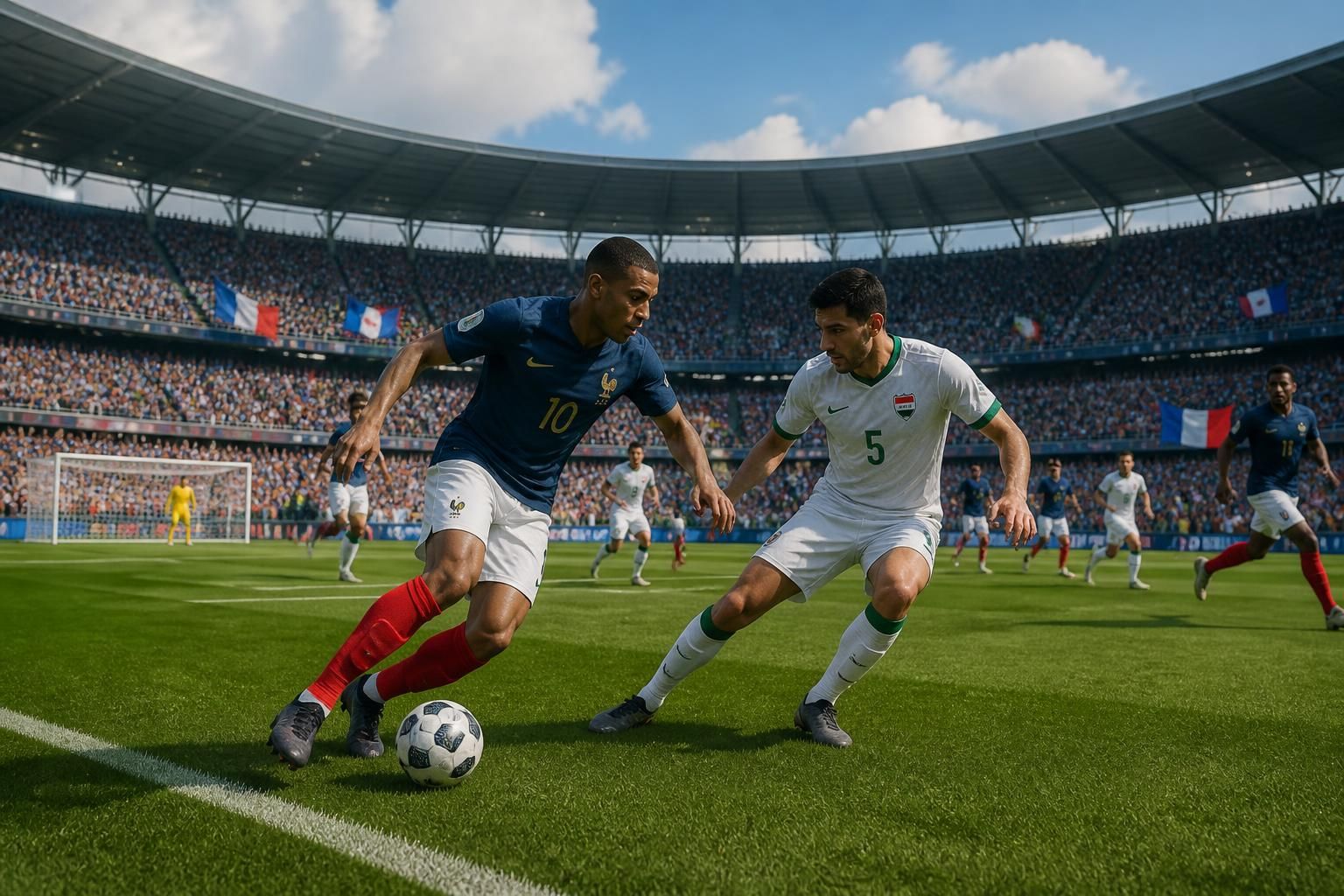
- The France-Iraq simulation on EA Sports FC 26 serves here as a decoding support: tempo, attack zones, goal profiles, and match scenarios.
- Several public simulators claim to run the entire tournament up to a final in New York / New Jersey, with formats ranging from a simple bracket to match engines.
- The most credible simulation formats remain those that explain their criteria (attack, defense, form, experience) and allow score editing.
- In practice, the interest is not to “predict” down to the last word, but to identify the sequences where France can turn the game around.
On December 5, 2025, the draw for the 2026 World Cup set a tangible stage for fans… and an ideal playing field for simulation tools that like to unfold an international competition match by match. In this context, the France-Iraq duel lends itself particularly well to video game decoding: the theoretical level gap exists, but a scenario can quickly twist on a match event, a failed pressing, or a poorly managed transition.
The approach is simple: use a simulation on EA Sports FC 26 as a reading grid, not as an oracle. Recurring sequences observed (low build-up, set attacks, set pieces, counter phases) explain why a football match can lock down, then suddenly open up. The challenge is also to understand what these engines reproduce well (rhythm, space occupation, link-ups) and what they model less finely (emotional management, refereeing, competition context). The result is a “TV” style decoding, but with a controller in the background.
France-Iraq Decoding at the 2026 World Cup: What the Simulation Really Reveals
A useful simulation starts with a simple reading: how the favorite team creates chances, and how the underdog survives weak moments. In a typical reconstruction, France sets up high, tries to fix play on the sides then attack through the middle, while Iraq favors a compact block and quick outlet upon recovery.
The video game often highlights a key point: the earlier France accelerates, the more it exposes itself to “dirty” ball losses that trigger counters. Conversely, a more patient circulation ends up stretching the block and opening up shots at the edge of the box. The match is then read in sequences, not in overall possession.
Hot Zones: Flanks, Half-Spaces, and Second Ball
In EA Sports FC 26, differences are mainly seen in repetition: France more often creates crossing situations on the move and overlaps near the box, while Iraq looks for more direct balls, prioritizing the second ball.
In this type of match, the danger on the French side often comes from a detail: losing cover when the fullbacks push forward. In the simulation, an intercepted clearance is enough to create a one-on-one, even against a dominated opponent. This is a useful reading for decoding: the best teams sometimes concede their clearest chances due to their own execution errors.
Simulation on EA Sports FC 26: Settings and Limits to Know Before Drawing a “Prediction”
The credibility of a simulation depends less on the final score than on its settings. Difficulty, goalkeeper level, fatigue, pressing aggressiveness: all these change the nature of the match. A “realistic” game on paper quickly becomes a transition festival if the rhythm slider is set too high.
The often overlooked point is repeatability. Across ten simulations, the same game plan can produce different stories, as engines handle an element of randomness: rebounds, duels, tackles, favorable counters. Proper use consists of identifying the scenarios that appear most often (where chances arise, how goals fall) then comparing them to what is seen in real football.
A Concrete Reference: What “Bracket” Simulators Do Compared to a Match Engine
The online simulators for the 2026 World Cup do not all play in the same category. Some require entering scores and then unfold the bracket; others claim to automatically simulate all matches. The result does not carry the same weight for match decoding.
For example, AIxploria presents a simulator that claims to rely on the draw of December 5, 2025, and a rating based on four criteria (attack, defense, form, experience), before running all 104 matches of the international competition, from the group stage to the final. Other tools emphasize the bracket: choice of qualifiers, score editing, final bracket projection.
Overview of 2026 World Cup Simulators: What They Contribute to Match Decoding
To prepare a match like France-Iraq, the interest of these tools is not to replace analysis, but to quickly test hypotheses: team that scores early, underdog that holds 0-0 for a long time, match that pivots on set pieces. “Bracket” simulators are perfect for visualizing a path, while a video game style engine better helps dissect football sequences.
Here are the most frequently used platforms, with their concrete differences.
- AIxploria (AI simulator): highlights a rating based on four criteria (attack, defense, form, experience) and claims to run 104 matches of the tournament, from group stage to final.
- FIFA 2026 World Cup Simulator — Predict the Champion: bracket-oriented, with score editing and a final held in New York / New Jersey.
- Simulator · 2026 World Cup: “click the winner” format to advance teams in the bracket, effective for visualizing the path.
- Play with our 2026 World Cup Result Simulator: emphasizes simulation and sharing of a complete groups + knockout bracket.
- 2026 World Cup Simulator – Create Your Scenario: multi-stage build, from group rankings to the final, “scenario” logic.
- MadeInFOOT (prediction simulator): offers to fill in group stage scores (presented as 72 matches) then generate qualifiers and final bracket.
- L’Équipe (simulator): emphasizes the ability to “shape the tournament according to one’s predictions” ahead of the competition.
| Tool / type | Measurable user input | Announced measurable output | Main interest for a France-Iraq match |
|---|---|---|---|
| EA Sports FC 26 (match engine) | Duration (e.g., 2×6 to 2×10 min), difficulty, play style, pressing | Match stats (shots, simulated xG according to engine, possession, fouls) | Understand sequences (transitions, crosses, set pieces) and recurring scenarios |
| AIxploria (AI simulator) | Announced criteria: attack, defense, form, experience | Announced progression of 104 matches up to the final | Test complete paths and estimate the impact of a global “level” |
| Bracket Simulator “Predict the Champion” | Score entry, group rankings | Final bracket up to the final in New York / New Jersey | Visualize potential opponents and qualification logic |
| “Click the Winner” Simulator | Binary choice each match | Complete final bracket | Quickly compare several scenarios without entering scores |
Privacy and Cookies: What These Tools Often Collect During a Simulation
Behind a 2026 World Cup simulator, consent banners remain a mandatory step, especially when the tool is tied to advertising. The options offered are similar: measure audience, secure the service, limit spam, and if the user agrees, personalize content or ads.
A frequent example in the web ecosystem: pages indicate they use cookies to maintain the service, track outages, and fight fraud, then, if accepted, develop new services and measure advertising effectiveness. In refusal mode, non-personalized content generally relies on the page visited, session activity, and a general location. This framework has a concrete impact: two users can get different recommendations around the same simulation, even if the underlying tool does not change.
What Do We Say About It?
The decoding of a France-Iraq via an EA Sports FC 26 simulation is mainly valuable for reading scenarios, not for the “predicted” score. The recurring sequences in the game (low block, transitions, crosses, second ball) offer a clear angle to follow the match and spot moments where France must accelerate without losing balance. For a tournament view, bracket simulators are practical, but they poorly tell the dynamics of a football match. The best use is to cross the two: match engine for sequences, bracket for the path.
Can an EA Sports FC 26 simulation serve as a reliable prediction for France-Iraq?
It can help frame plausible scenarios (early goal, sterile domination, counterattacks, set pieces), but a strict prediction remains fragile. Settings (rhythm, difficulty, pressing) and engine randomness strongly modify the unfolding. The good indicator is not the single score, but the repetition of sequences over several simulated matches.
What is the difference between a “bracket” simulator and a video game style match simulation?
A bracket often requires choosing winners or entering scores, then generates the final bracket. It is useful to visualize a path in an international competition. A video game style simulation rather produces game phases (transitions, crosses, shots), which serves more for tactical decoding of a match like France-Iraq.
Why do some simulators announce 104 matches for the 2026 World Cup?
Some tools present a complete progression of the competition, from the group stage to the final, with a total announced of 104 matches. This number is used as an argument of exhaustive tournament coverage. For analysis, it mainly allows producing path projections, not guaranteeing the accuracy of an isolated match.
What should be prioritized in a France-Iraq decoding based on simulation?
Three points provide concrete references: the quality of Iraq’s ball outlet under pressure, France’s ability to create chances through the middle rather than multiplying crosses, and management of high ball losses triggering counters. These elements quickly appear in conceded chances on a simulation.