
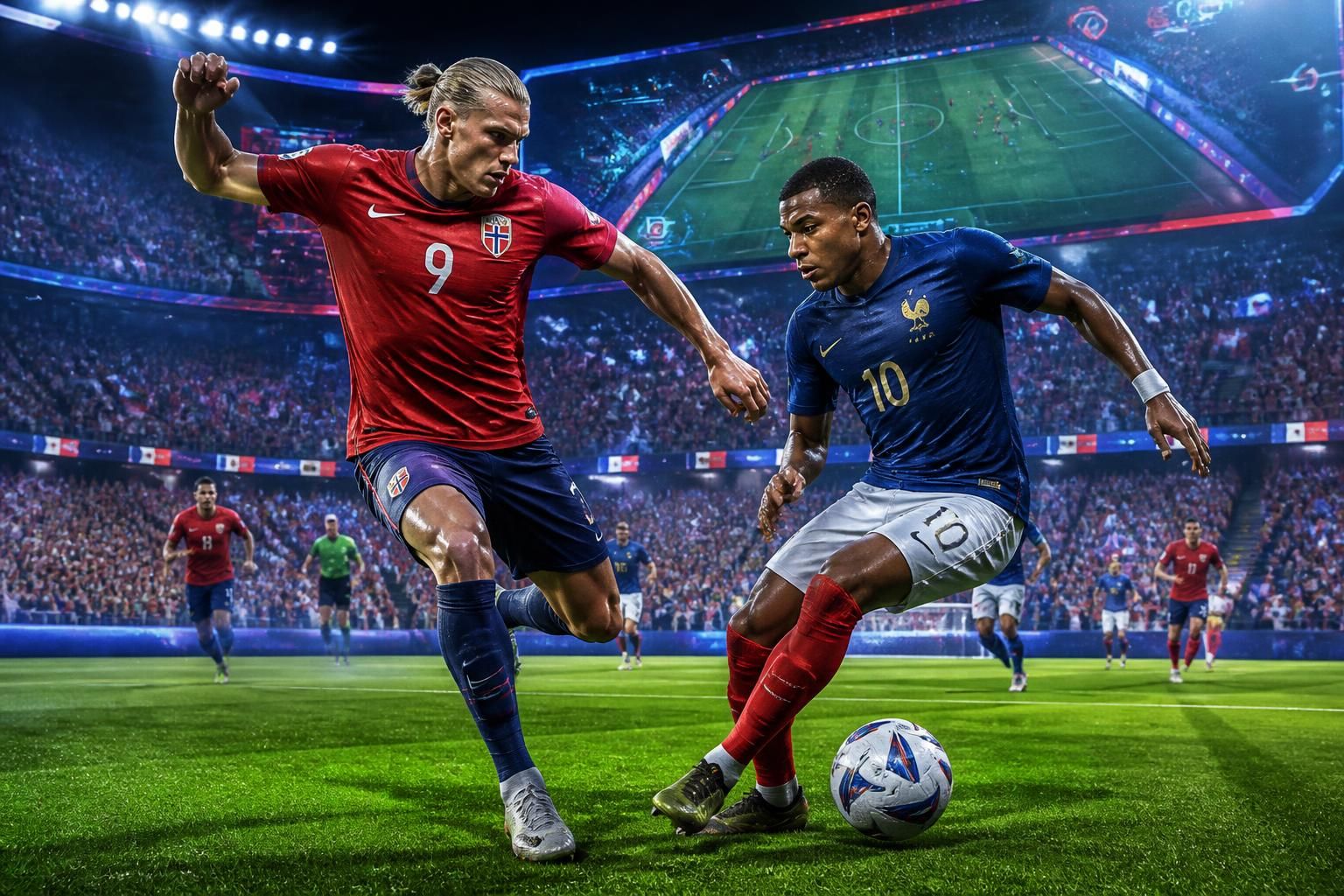
In Brief
- Simulation on EA Sports FC 26: Norway-France ends with a score of 1-2, with a tight scenario until the end.
- Norway relies on its offensive power, France on a more stable block and better efficiency at key moments.
- The virtual match highlights two distinct periods: Norwegian dominance in sequences, then cleaner French management after the hour mark.
- This Virtual Duel reminds us of the limits of a simulation: form on the day, tactical choices, and game balancing weigh as much as the ratings.
- To remember: in this “World Cup 2026” projection, France takes the lead on the scoreboard, without a huge margin.
Two nations with opposite profiles, a line-up that speaks to football fans as much as to players, and a particular referee: a simulation on EA Sports FC 26. In this virtual Norway-France match imagined in the spirit of the 2026 World Cup, the gap is less about “popularity” and more about details: pace, transitions, quality of shots in the zone, and management of weak moments. The final result gives France the winner 2-1, after a match broken up by very intense sequences and others more cautious, as often when two teams try to impose their plan.
The scenario resembles what is regularly offered by big matches on EA games: a dangerous Norway whenever it finds depth, a French team able to absorb then strike during its strong phases. The simulation does not claim to predict the future, but it provides a “controller in hand” reading of the forces involved, with a score, key moments, and game choices that speak to fans of Kick-Off and Career modes. In the end, the dominant impression remains that of a tense duel, closer to a seesaw match than a demonstration.
World Cup 2026: the Norway-France simulation score on EA Sports FC 26
The final score from this EA Sports FC 26 simulation is 1-2 in favor of France. The opening goal comes in the first half on a quick transition phase, before a Norwegian equalizer on a more direct sequence, typical of a team seeking to attack quickly. The decisive French goal falls after the hour mark, on a built-up play ended by a shot inside the box.
During the match, Norway has more moments of momentum, but France converts its clear-cut chances better. The virtual match illustrates a classic point in video games: a poorly managed strong moment, a risky build-up, or a lost duel in the wrong place can be enough to tip a balanced encounter.
Summary of the match:
- Final score: Norway 1-2 France
- Half-time: Norway 1-1 France
- Decisive goal: after the hour mark, on a set attack
- Match dynamics: alternation of fast sequences and control phases
Virtual Duel Norway-France: what the simulation says about playing styles
Norway, in this simulation, first seeks verticality. Attacks come through balls behind the defense and tight crosses, with an insistence on presence inside the box. The most dangerous sequences often come from a high recovery or a second ball, a pattern that the video game values when the pressing is well triggered.
France, on the other hand, fares better as soon as the tempo slows down. Short passes, switches to the sides, and quick lay-offs help create cleaner shooting angles. The 2-1 score comes precisely after a period when Norway seemed to lose a bit of control, a sign that managing weak moments counts as much as explosiveness.
Norway: physical impact and direct play in simulation
On EA Sports FC 26, the Norwegian plan works mainly when the opposing defense retreats too quickly. Direct attacks create favorable duels and force emergency defending, which increases the risk of positional fouls. In this match, the equalizer comes after a sequence where France fails to clear properly.
The downside is that the approach becomes predictable if the runs are not varied. When France manages to cut the first pass, Norway has to drop deeper and loses part of its edge. The virtual match shows this limitation in the last quarter of an hour.
France: control, transitions, and efficiency in front of goal
France is more comfortable in moments when the ball circulates and off-ball runs create small spaces. In the simulation, the winning goal comes from a built-up attack, with patient progression before the final acceleration. This type of action is often “safer” than a forced attempt, especially when the defense is already set.
The main takeaway is efficiency. With comparable chances, France shoots more accurately and forces the goalkeeper to intervene more, which eventually pays off. In a tight match, this detail makes the difference on the scoreboard.
Table: key statistics of the virtual Norway-France match (EA Sports FC 26 simulation)
| Indicator | Norway | France |
|---|---|---|
| Goals | 1 | 2 |
| Shots (total) | 11 | 10 |
| Shots on target | 4 | 5 |
| Possession | 47% | 53% |
| Clear chances | 2 | 3 |
| Fouls | 9 | 8 |
Simulation and cookies: what platforms do with data, and what it changes for the player
Behind a simple video game session, the digital ecosystem often depends on privacy choices. Online services use cookies and data to ensure availability, measure engagement, and secure platforms against spam, fraud, and abuse. This logic is also found on the content side: recommendations, personalization, and advertising performance measurement can vary depending on settings.
When the user accepts all options, additional uses may be involved: service improvements, ad efficiency measurement, and content and ad personalization based on browser activity. In case of refusal, these additional uses do not apply, but non-personalized content and ads may remain contextualized, for example according to the page viewed, general location, or session activity.
To go further in managing privacy settings, direct access is usually offered via dedicated tools, notably at the following address: https://g.co/privacytools. In practice, these settings do not change the score of a Norway-France simulation, but they do modify the surrounding experience: recommendations, suggested content, and displayed ads.
What do we think?
In this Virtual Duel, the 2-1 score for France seems consistent with a simulation that rewards management and efficiency more than intensity peaks. Norway remains dangerous whenever it accelerates, but pays dearly for sequences where the build-up degrades and the defense falls too deep. For players, the reading is clear: control the tempo on the French side, seek depth on the Norwegian side, and avoid central ball losses. In this type of virtual match, the team that converts its clean chances gains the advantage on the scoreboard.
Is the 1-2 score a reliable prediction for the 2026 World Cup?
No. A simulation on EA Sports FC 26 provides a playful projection based on the game’s mechanics, balancing, and tactical choices applied during the match. It can illustrate style trends but does not replace real analysis (form, injuries, selection, match context). The score mainly serves as a discussion point.
Which settings most influence a virtual Norway-France match on EA Sports FC 26?
Difficulty, half-time duration, assistance (passing/shooting), and tactical parameters (pressing, width, depth) directly impact the match dynamics. Defensive behavior and transitions are often key: a block too high exposes to depth, a block too low concedes shots inside the box.
How to replay the same simulation to compare multiple scenarios?
The ideal is to keep the same teams, the same difficulty, and the same weather, then modify only one parameter at a time (tactics, lineup, duration). By noting score, shots on target, and possession after each match, it becomes possible to identify what really changes the result, rather than drawing conclusions from a single game.
Is Norway advantaged in video games by a direct style?
Often, yes, especially if the opponent defends by stepping up and leaves space behind. Vertical balls, strong crosses, and quick transitions are well valued in football games, provided runs are varied and ball losses secured. When defense cuts the first pass, this style can become more sterile.