
In Brief
- EA Sports has officially announced a World Cup mode in FC 26, the first since the break with FIFA, under the name “The World’s Game” (name mentioned several times in announcements).
- The announced format targets 48 teams and a fully playable tournament from start to finish, but without the official competition branding (trophy, visual identity, “real” groups).
- Several dates circulate according to publications: Wednesday, May 27, 2026 is cited as the “World Cup-inspired” launch window by content relaying leaks, while June 4, 2026 is given as the arrival date of the 48-team tournament in other articles.
- The exact list of excluded countries depends on rights and licensing agreements: some nations may appear with generic rosters, others absent if the federation is under a competing exclusive licensing.
- The major gameplay challenge is balancing the specific rules (fatigue, cards, extra time, penalty shootouts, injury management) to make the virtual competition more of a “tournament” than just a series of friendlies.
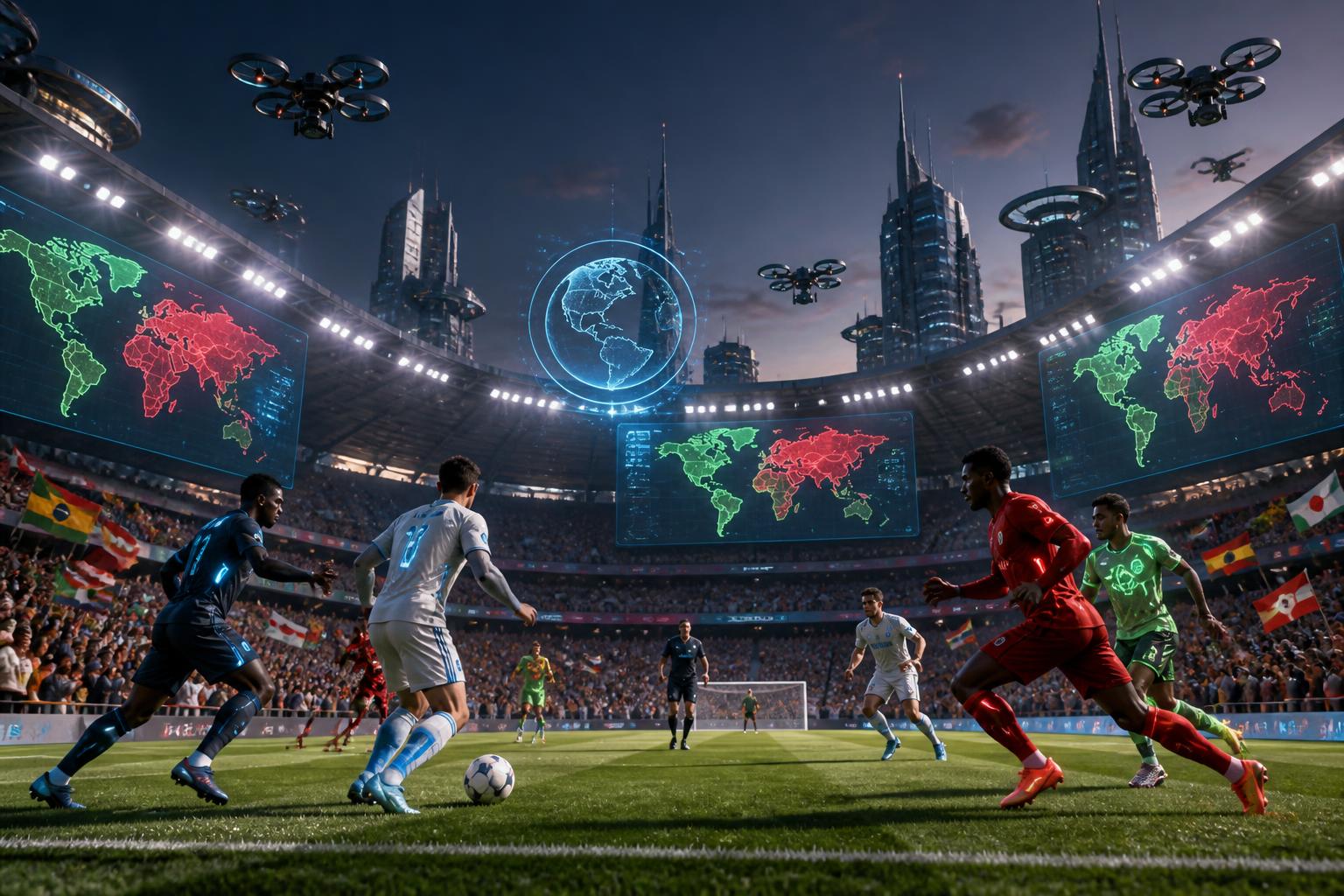
In FC 26, EA Sports finally puts a World Cup game mode back on the table, a highly anticipated return since the end of the FIFA era in the franchise. The concept is clear: to offer a complete playable tournament with an expanded cast, sticking to the 48-team format popularized for the current international cycle, but without relying on the FIFA brand and its “signature” elements (trophy, branding, official terminology). The result: the promise looks like a World Cup, plays like a World Cup, but appears as a homegrown event.
This mismatch changes several things for players. On one side, content can arrive faster and evolve more freely, with innovations in interface, progression, and match scripting. On the other, compromises must be accepted: excluded countries due to licensing agreements, non-official or renamed stadiums, and sometimes presentation rules that differ from TV “broadcast” standards. This complete guide reviews what has been announced, what is plausible on the licensing front, and what this tournament mode can really bring to the virtual competition.
World Cup Mode in FC 26: What Has Been Announced, and What Has Not
Several articles indicate that EA Sports has officially announced the arrival of a World Cup mode in FC 26, described as the first of its kind since the split with FIFA, titled “The World’s Game.” The same sources mention a 48-team tournament, presented as a structured experience rather than just a simple match menu.
At the same time, these articles stress one key point: the lack of official competition rights. Practically, this means the absence of the “real” trophy, a graphic charter identical to that of the tournament, and, according to the terms employed, the absence of the “real groups” pre-established. This choice does not prevent playing a full virtual competition, but it conditions the way the mode is packaged and named.
Schedule: Diverging Dates According to Publications
A source relaying leaks mentions a launch on Wednesday, May 27, 2026 for a “World Cup-inspired tournament mode.” Other texts give an arrival of the 48-team tournament on Thursday, June 4, 2026, positioned as “without FIFA license.”
Due to the lack of a verbatim and dated press release in the available elements, these two milestones should be read as windows reported by different publications, and not as an officially consolidated timeline by the publisher. For players, the impact is mostly practical: to watch for content updates, as a tournament mode can be deployed in several stages (menu, teams, then live events).
Countries Excluded in FC 26: Why Some Teams May Be Missing
The issue of excluded countries inevitably arises whenever a football game announces a World Cup mode without a FIFA license. Rights are not limited to a logo: they cover federations, certain teams, sometimes stadiums, and even exclusivity agreements signed with competitors.
In practice, a tournament mode can handle absent nations in three ways: complete absence, presence with modified name/badge, or “generic” presence (fictitious player names, non-official kits). The gameplay experience differs: a 48-team bracket loses credibility when several major nations are replaced by placeholders, especially in a virtual competition designed to be replayed dozens of times.
What Triggers a Country’s Absence: Licenses, Federations, and Exclusivities
Typical cases are well known to players: a federation may sell its rights to another game or impose conditions (names, equipment, sponsors) incompatible with an event mode. In these situations, EA Sports can retain players via clubs but lose the national branding, which directly impacts a World Cup mode.
A practical example on usage: in single-player, the presence of a generic team is less problematic if the goal is to chain “what-if” matches. In local multiplayer, however, the “World Cup” argument also relies on perceived authenticity, and excluded countries become an immediate point of friction.
What Players Can Quickly Check on Launch Day
- The complete list of available teams in the tournament menu (48 slots, or fewer if some slots are locked).
- The level of team authenticity: real names, real rosters, official or generic kits.
- The ability to manually replace an absent nation with another (tournament cast editing).
- The availability of a roster download or dedicated update to add teams afterward.
Specific Tournament Mode Rules: What FC 26 Must Change to “Feel Like the World Cup”
A credible World Cup game mode is not satisfied with just a knockout tree. It must enforce specific rules and constraints that change the rhythm: limited recovery, card management, squad selection across multiple games, and real impact of injuries. Without this, the virtual competition resembles a sequence of matchups without tension.
The 48-team format also implies a denser group phase, with more matches to play or simulate. The sensitive point becomes readability: schedule, ranking, tiebreakers, and opponent coherence. A poorly designed tournament interface ruins the desire to restart a campaign, even if the gameplay on the pitch is solid.
Parameters That Make the Difference in Single Player
In a tournament, the player must feel that choices have consequences. A badly managed rotation must have a cost on fatigue. A yellow card must weigh on the next match, and an accumulation must trigger a suspension visible in the team menu.
A textbook case: a weaker team might aim for a “useful” draw in the group stage, then lock an eighth-final with a long match, accepting to play extra time. If FC 26 wants this scenario to exist, it needs AI behavior settings and management of low phases that do not just reduce to “attack fully.”
Key Points in Multiplayer (Local and Online)
Online, specific rules must be transparent and anti-abuse: penalty shootout settings, goalkeeper behavior, and balance of playing styles in a knockout match. An “event” tournament also attracts very different profiles, from casual players to competitors.
The classic trap is leaving settings too permissive: if injury time or defensive aggressiveness are exploitable, the meta crushes the World Cup spirit. A successful tournament mode must channel these extremes, especially when the 48-team format multiplies matches.
Innovations Compared to FIFA: What FC 26 Can Allow Without an Official License
The absence of a FIFA license is a brand constraint, but it also opens doors. Without an “official” specification sheet, EA Sports can offer a tournament in its own way: internal narration, challenges, squad objectives, or mini-events reacting to results. This is where innovations can compensate for the absence of an iconic trophy.
An expected avenue is customization: choosing “neutral” stadiums, modifying qualification rules, or launching variants (quick tournament, shorter groups, immediate knockout). This type of flexibility appeals to players restarting a campaign, not just those wanting to replay “like on TV.”
Dynamic Events and Objectives: The Most Credible Lever
In a World Cup mode, replayability relies on more than spectacle. Contextual objectives (win without conceding, achieve a certain number of shots on target, play a young player) can give an identity to each run, especially if cosmetic rewards are tied to the tournament.
A concrete community example: these challenges often create “home challenges” on social networks and streams, because they provide a clear framework and shareable results, even without a FIFA license.
Comparison Table: What a “Non-Licensed” World Cup Mode Changes in FC 26
The table below summarizes the typical differences between an officially licensed tournament and an internal tournament mode, as described in the available elements (48-team tournament, absence of official trophy and branding, non-predetermined groups).
| Measurable Element | Officially Licensed World Cup | World Cup Mode in FC 26 (According to Available Elements) | Player Impact (Concrete) |
|---|---|---|---|
| Number of Teams | 48 | 48 (announced in multiple texts) | More matches, increased rotations |
| Trophy and Visual Identity | Official (logo, TV overlay, trophy) | Non-official (trophy and branding absent) | Weaker visual authenticity, variable immersion |
| Pre-established “Real” Groups | Yes, according to official draw | No, groups not “real” as stated | More replayability, less faithful recreation |
| Availability of Teams | Complete (in theory) | Depends on licenses, risk of excluded countries | Reduced choice, possible generic teams |
What This Mode Really Brings to the Virtual Competition, Controller in Hand
The core issue is not the FIFA brand, but the quality of the tournament mode. If FC 26 offers a clear structure, coherent settings on fatigue and discipline, and an AI capable of “high-stakes” play, then the experience will stand out clearly from personalized tournaments hacked together in the standard menus.
Conversely, if the tournament merely strings matches together without constraints and without narrative, the lack of official branding will be much more apparent. In that case, the World Cup mode will look like a temporary marketing event, not a cornerstone of the game mode.
A Simple Evaluation Grid to Decide if It’s Worth It
- If the mode enforces real squad management over 7 matches, it has a “tournament” identity.
- If the list of nations is robust despite excluded countries, immersion remains solid.
- If menus allow quickly restarting a campaign (simulation, clear schedule), replayability follows.
- If rewards are tied to progression, the tournament becomes an objective, not a curiosity.
What Do We Say About It?
On paper, FC 26 has an ideal window to place a World Cup mode at the center, even without a FIFA license. The 48-team format and a complete tournament mode may suffice, provided the specific rules truly change how a campaign is played. The most probable weak point remains the perception of authenticity if too many countries are excluded or generic teams accumulate. The strongest scenario is an evolving “event” mode, enriched by updates, rather than a fixed official recreation.
Is the World Cup mode in FC 26 free or included in the base game?
The available elements mention a World Cup mode integrated into FC 26, with wording that varies by articles. Without mention of a specific and dated paid pack in this information, the most realistic expectation is an addition via content update, accessible from within the game, possibly with cosmetic elements linked to progression.
Can you play a full 48-team tournament in FC 26?
Several texts describe a 48-team tournament, presented as the core of the mode. The point to check at launch is the effective presence of 48 playable teams and how the game handles license absences: replacement, generic teams, or unavailable slots. The structure (groups, knockout) must also be readable to sustain a full campaign.
Why might some countries be excluded from the World Cup mode?
Excluded countries are most often a consequence of licenses and federation agreements, sometimes under competing exclusivity. This can prevent the use of the official name, kits, badge, or even the team itself. In a tournament mode, these absences are immediately noticeable because they affect the credibility of the international cast.
Which specific rules make a tournament mode truly resemble a World Cup?
The important settings are those imposing consequences across multiple matches: fatigue and recovery, card and suspension management, injury impact, extra time and penalty shootouts, and a coherent schedule. Without these constraints, even a 48-team bracket looks like a series of isolated matches, with less strategic tension.